A Singular Reading Experience
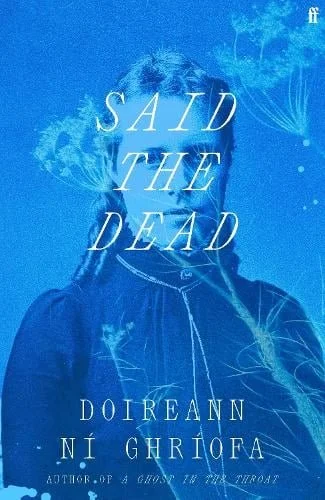
Reading this book was very beautiful and moving, but also extraordinary because it's such a singular experience. “Said the Dead” by the Irish author Doireann Ní Ghríofa is essentially unclassifiable — you could call it a novel, a memoir, an essay, poetry, or social history, and it is really all of those things at once.
Premise
The book follows someone, presumably the author herself, as she passes by a building that was once a mental hospital in Cork. She meditates on how, if she had been alive in the 1800s, she probably would have ended up a patient at this institution herself, given her unique personality. She becomes intensely drawn to the location, and especially to the women who were patients there for so many years, and starts haunting the structure herself, hanging around the construction site where it's being redeveloped, looking in on it. She also delves into the institution's archives, surveying censuses taken in the area to gather details about the women who lived there. Through those small details, a much larger picture emerges of the state of women in Ireland at the time.
The institution first opened in the early 1800s and became a state facility around the 1850s. The records mostly capture the doctors' perceptions of these women's lives and symptoms, and have to be taken with a pinch of salt for that reason. Quite often, the only note recorded about a woman over the years is "no change, no change." That phrase comes to reflect back on the narrator's own life too, since she describes herself as a wife, mother, and reader whose domestic routines can feel like they carry no change from week to week or month to month. She feels an intense identification with these women, and a sense that she can almost hear their voices reaching out to her from the past — while also feeling, in turn, that she is haunting them, peering in on their lives. She poses a striking question: “Who chooses the sight of a vision? The witness or the apparition?”
Psychological, Supernatural, Mythological
I don't personally believe in anything supernatural, but what I found so interesting is how this book plays on the line between the psychological and the supernatural. There's so much in Irish life and history that carries a sense of mythology and connection with the past — in the Fenian Cycle and broader Irish mythology, there's a sense of previous inhabitants of an area dissolving into the ground, so the land itself becomes sentient, reaching out to people in the present and helping steer their lives. I think that's a rich tradition Ní Ghríofa is drawing on here, even while she's also documenting how many of these women were genuinely marginalized figures: some clearly suffered from real mental conditions that made a traditional home life untenable, while others were pushed aside because they were suffering abuse or neglect, or because husbands simply didn't want to deal with them anymore. Some stayed only a short time before being judged "rehabilitated" and released; others stayed for years, or until their deaths.
Piecing Together Lives from the Archive
The narrator becomes a kind of diver into the lives of these women, piecing together their circumstances from doctors' notes and census records, and imaginatively building out the parts that the records can't tell her — conjuring a probable picture of these women's mindsets. Part of her access comes through a doctor at the institution named Lucia Strangman, the first woman to qualify as a psychiatrist in the British Isles, who worked there for many years and, by the book's account, had real sympathy for her female patients and tried to help them become healthier. Lucia becomes the narrator's key not just into individual lives, but into how the institution itself was run — predominantly by men, which shaped how women's symptoms were interpreted, classified, and treated.
The narrator often catches herself questioning how much she can really trust these accounts, especially from the male doctors, and how much can genuinely be gleaned from a census and the details it includes — or the details people chose to omit because they didn't want to be officially classified this way. Part of the book grapples with the real difficulty of researching these women's lives: the archive is publicly available only up to about a hundred years ago, after which point access is restricted to protect the privacy of more recent patients. That's the right call, but it also blocks her from finding out what ultimately happened to a number of the women she becomes invested in. She's also restricted from recording their real names. She invents pseudonyms but wants to record their true names, believing these women would have wanted to be properly known and remembered.
Alongside the text of the records are scattered photographs of some of these women, some reproduced in the book itself. She writes that she can't get the thought of their images out of her mind once she's seen them, and the text about their lives is layered over these old photographs, which carry an eerie sense of specters brought into the present. There's so much of this book that functions as a ghost story — though it keeps posing the question of who exactly the ghost is: the reader in the present, the author of this book or the women from the past?
Obsession and Home Life
The narrator becomes so engaged with these women's lives that she finds herself dwelling around the structure as it's being converted into apartments, having odd encounters with construction workers questioning what she's doing there, and small battles with librarians and archive keepers as she tries to find out as much as she can. She recognizes that, in becoming so obsessed with this project, she's in some ways neglecting her own home life, her family, her children — and there's a real self-questioning thread about why this matters so much to her when she feels she should be focused on her own family. But it's clearly important to her personally to honor and recognize these women, to really hear their voices and help preserve them, and there's a touching nobility to the project — most of these women would likely have been entirely forgotten if Ní Ghríofa hadn't written this account.
One of the women's stories I found especially touching is that of a woman named Dora, a committed reader who found in literature a kind of escape and a way of staying sane in a world that felt uncontrollable to her. The book also maps these women across periods of history — when the narrative reaches the early twentieth century and the First World War, there's real, palpable fear and depression among the women for family members who might be sent to fight, layered on top of whatever conditions they already carried. Many of the symptoms described, like severe depression after giving birth, are conditions we'd now readily recognize and treat, but at the time were widely misunderstood, dismissed, and used as further reason to push these women aside.
Comparison with Other Recent Irish Books
Reading this, I found myself thinking about other recent Irish literature. There's Jan Carson's novel “Few and Far Between”, set on an archipelago off the coast of Ireland, which includes a facility housing patients who have gone completely silent — comatose in the sense that they can no longer communicate, most often because of some massive trauma that has caused them to entirely mentally shut down. I also thought about Maggie O'Farrell's new novel “Land”, and the way mythology and its relationship to landscape plays such a large part in that book too. There's so much great new Irish literature being published right now, and I love how these books feel like they're partly in conversation with each other — looking at some of the same questions from different angles and different perspectives.
The Writing Itself
What Ní Ghríofa is really writing about is this connection with the past, with people from the past, and how different we actually are from them in the present — how much we can identify with those who have been lost, whose voices are mostly gone except for whatever traces in records we can find. There's a gorgeous lyricism to her writing, and a sense of creating a touchstone with history that I found incredibly moving. One line I noted down: “It was a relief to be absent from herself. If she was absent, who was present?” This question casts an eerie shadow over the book, but it's also quietly probing where the self actually exists, and who we are, if we're identifying so strongly with people from the past that there's both a strong sense of connectedness and an absolute absence of self.
Verdict
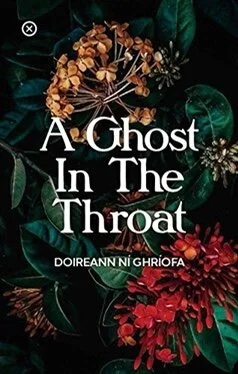
This book poses much larger questions about identity while specifically working through the records of these women's lives, and there's such a sense of compassion in it, alongside a genuine questioning of who we really are and where we fit into the past. I absolutely loved reading it, and I'd been eager to get to it ever since reading the author's previous book, “A Ghost in the Throat”, which is another extraordinary and singular reading experience — there, the author connects just as strongly with a specific figure from the past, a poet, looking at similar questions of history and psychological and social struggle that still resonate in the present. I sank into this new book completely as it's such a strange and searching experience.