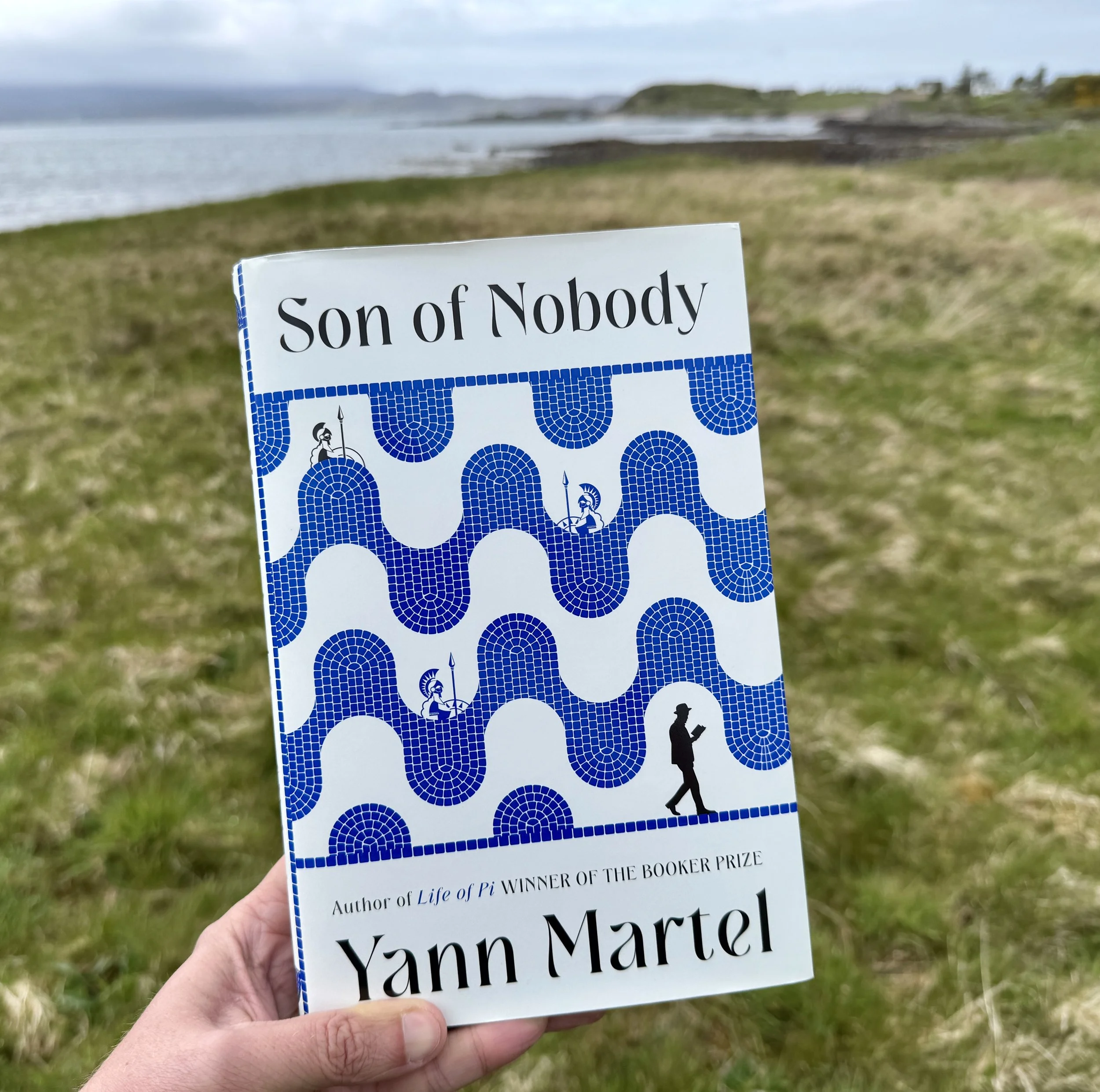
The most noticeable thing when starting to read “Son of Nobody” is how the story is divided into The Psoad, an imagined newfound epic poem which follows the Trojan war from the point of view of a foot soldier from Midea, and footnotes by their translator, the Classics academic Harlow Donne. I usually read footnotes in books if they are brief and interesting enough not to disrupt the flow of the story. Of course, in Martel's novel these footnotes are an integral part of the novel since Harlow's personal tale runs alongside and, in a much more humbler and more domestic way, mirrors the dramatic tensions raised in this alternative version of the Greek-Trojan war myth recorded on pottery fragments. I enjoyed how much space was given to these notes on the page to emphasis how they really need to be read. I was also glad the book included some maps of these ancient regions alongside (maybe less necessary) illustrations of animals. Once I got into the rhythm of the story I enjoyed going back and forth between these sections and how The Psoad comes to take up more space towards the end.
Of course it's not necessary to have read “The Iliad” to read and enjoy “Son of Nobody”. In fact, Martel wrote this novel mindful that many readers probably won't have read it. In some ways “Son of Nobody” could serve as a helpful primer for going to read “The Iliad” afterwards since he gives a useful breakdown of which Gods support which side of the war and goes to great lengths to explain the overall story and context of Homer's epic. I started reading “The Iliad” for the first time a couple of weeks ago, but I'm experiencing it through the complicated process of both listening to the Emily Wilson translation on audiobook and reading sections of the translation by E.V. Rieu (revised and updated by Peter Jones and D.C.H. Rieu) and I'm enjoying it immensely. I think it helps that I had some familiarity with the Greek Myths and the overall story of Homer's epic before going into it. I won't go into much detail about my reaction to “The Iliad” here but, as Martel points out, the only voices we hear in “The Iliad” are almost exclusively from leaders or Gods. “The Iliad” does give small insights into the lives of many others and I've been most struck by descriptions of soldiers on the battlefield knowing they are probably about to die. While I enjoy rolling my eyes at the pettiness and arrogance of many of the authority figures I have found myself longing for the points of view of common people caught up in this drawn-out war.
In recent years there has been a slew of novels whose stories revise the famous Greek myths, many of which focus much more on a female or queer point of view. But I like that Martel has taken a slightly different approach focusing on class rather than gender. I appreciated the (mostly) believable imitation Martel gives with The Psoad as it matches the tone and manner in how the famous epic sounds as it began as an oral tale. I especially liked how The Psoad creates a sense of atmosphere and drama, the anticipation of the soldiers reaching Troy and the tragedy of ships initially lost in the approach. There's one story about a citizen of Troy and his table which is gradually left with four empty sides which was especially poignant. The choice to reveal the bard of this epic as Thersites was clever as he's the sole voice of dissent and a representative of the common people in “The Iliad” questioning the authority figures. It was especially pleasing the way that the voice in The Psoad slyly mocks the arrogant powerful figures calling the shots, especially when Hades enters at one point to deliver hilarious views and comments on these supposedly great men. I really like how Hades enters Martel's narrative because he's always struck me as one of the most interesting Greek gods. He never initially wanted to rule over The Underworld but it was the realm he was obliged to oversee so he feels like a fascinatingly conflicted figure. The end of “Son of Nobody” is especially poignant and I like how it ties back in with the beginning of The Psoad.
Then there are the footnotes which are a combination of Harlow writing to his daughter Helen/reflecting on the disintegration of his relationship with his wife Gail and commenting upon the text of The Psoad. While there are some emotional moments in the story of Harlow's family life the majority of this aspect of the novel felt a little thin to me. The novel's structure didn't allow him to get into too much detail because it would overwhelm the footnote. So, while I appreciated Helen's pluckiness demanding a story from her father, the intimidating professor Franklin Cubitt and a harrowing storyline about illness and loss, I didn't feel as engaged by his family drama and the way Martel sometimes strained to draw parallels between Harlow's life and the lives in the epic. However, I did find it interesting to think about Harlow's dilemma pursuing his passion as opposed to staying with his family. It made me think about the way I spend so much time on my own reading in isolation rather than engaging with my partner or friends. Despite this, I was more drawn to Harlow's analysis of “The Iliad” vs The Psoad. He makes a lot of good points about inconsistencies and illogical aspects of Homer's epic and the actions of the Greeks and Trojans. It made me eager to return to “The Iliad” and newly consider aspects of it. As much as I appreciated this it also slightly distracted from my enjoyment of The Psoad because it came to make this poem feel more manufactured and gimmicky to suit Martel's points about egalitarianism rather than making it seem like an authentic found document.
Overall, I mostly enjoyed “Son of Nobody” and admire its big ambition (Martel really took on a huge task with creating both a classic and contemporary story) but some parts did feel a bit flimsy. I appreciate how this book prompts thoughts on the nature of storytelling and the role it plays in our civilisation, whose stories get told and why, and the way it points the reader back to “The Iliad” because there is a reason this tale is a foundational text in Western society. It's also fascinating to think about the point that so little in “The Iliad” or the gospels of the Bible can be verified: “It is curious how two stories that have so changed history are so very hard to place in history.” As Martel describes, the point of such stories aren't really about fact or fiction but serve another purpose in being a touchstone to the human condition. But “Son of Nobody” doesn't have the space to get into the full complexity of trying to connect the Bible and “The Iliad” including how it might have played into the formation of the gospels. So the links Harlow strives to make towards the end feel like a big stretch! But, of course, given the way professor Cubitt is so dismissive of Harlow's work perhaps we're supposed to question the rigour of his research and his findings. However, I reckon that Martel is more on Harlow's side with his sense that the traditional academic rigour applied to studying the classics can be too limiting. I felt “Son of Nobody” was an engaging and entertaining read. I was glad I read it but it's not a new personal favourite.