I don't think I've ever had this experience reading a novel before. The food descriptions in this story were so evocative and vivid that I literally had to go out and eat to satisfy the hunger this book made me feel. “Taiwan Travelogue” is a very clever book in a number of interesting ways. At its center is Chizuko, a successful Japanese woman writer in the late 1930s who gets the opportunity to go on a year-long lecture tour of Taiwan. She's paired with Chi-chan, a woman who speaks both Taiwanese and Japanese and accompanies her throughout the year. The novel follows their relationship, the ongoing effects of colonialism on Taiwan, and the two of them eating their way around the country, sampling an enormous range of dishes.
Of course, not every dish sounded appealing to me, there were definitely some I wouldn't want to try, but plenty of others sounded genuinely wonderful, and reading this left me so hungry that I went out and found a Taiwanese restaurant in London called Mr. Bao, where I kept reading while eating a yuzu salad, grilled broccoli, smacked cucumbers with chili, and delicious fluffy filled bao. It was deeply satisfying to actually taste this food while getting more and more descriptions of everything the characters were sampling along the way, since the Japanese author-narrator has a genuinely insatiable appetite, describing it at one point as a monster in her stomach that can never be satisfied.
An Outsider Seeking Authenticity
Chizuko is something of a glutton, but she also genuinely wants to experience the real culture and food of Taiwan, which becomes a slightly complicated ambition as the novel unfolds, since much of the food and language in Taiwan at this time has been so shaped by Japan, referred to in the book as "the mainland," with Taiwan as "the island," and a real, loaded distinction drawn between mainlanders, islanders, and those of mixed background. We watch real tension grow between the two women alongside genuine affection, and both are outsiders in different ways: the Japanese author is described as physically large, loud, and endlessly curious, wanting to get past a tourist's version of the country to something more authentic, while the Taiwanese translator is much smaller and far more circumspect about what she says.
I've noticed that a lot of other readers found the Japanese narrator fairly unlikable, but I found her quite sympathetic. She's a genuine outsider herself, always reserved and bookish, someone who says she never had friends at school, and when she meets the Taiwanese translator and feels a real connection, she wants a genuine friendship, even though there's a real power imbalance between them. As they travel, we learn the translator is betrothed to a man she's expected to marry, carrying real expectations tied to her background and station, and facing prejudice from other Taiwanese people that the Japanese author instinctively wants to defend her against, even though that impulse itself complicates the possibility of an equal friendship between them. There's a faint romantic edge to their relationship too, most vividly in a moment where the Japanese author feeds peeled lychee into the translator's mouth, but for the most part the novel handles that undercurrent, and the tensions running alongside it with subtlety, building toward a dramatic crisis point later on.
A Vanished Landscape
I loved that the book opens with a map of Taiwan as it existed at the time, which I found myself flipping back to constantly as the two women traveled north and south and encountered different people and places, some of which no longer exist in the same form, like a set of waterfalls once visible from a train that can't be seen that way anymore because the transportation system has since changed. It gives the novel the feeling of capturing a bygone era, with the Japanese author self-consciously trying to preserve the essence of the country as she experiences it, while the book keeps quietly raising the question of how much that experience has already been shaped by the outside imperialism of the colonizers who imposed their own culture and language on Taiwan. That question builds gradually until the Japanese author is forced into some real self-interrogation about her own role in it.
A Gentle Read with Real Depth
I really appreciated how gentle this book was, especially having read a number of other excellent but genuinely dark books recently. This one raises real, serious issues, but in a compassionate way following these two women traveling the country, their banter, and a massive feast prepared by a female master chef with course after course brought out to them. There's even an odd little interlude at a girls' school that turns into something like a Sherlock Holmes mystery involving strange nighttime happenings. This section felt a little out of place to me at first, though it ties back later, when the Japanese author is trying to piece together the translator's true history, since she's described throughout as wearing a kind of Noh mask that conceals her real feelings, something the narrator keeps trying, with real difficulty, to see past.
A Novel About Translation Itself
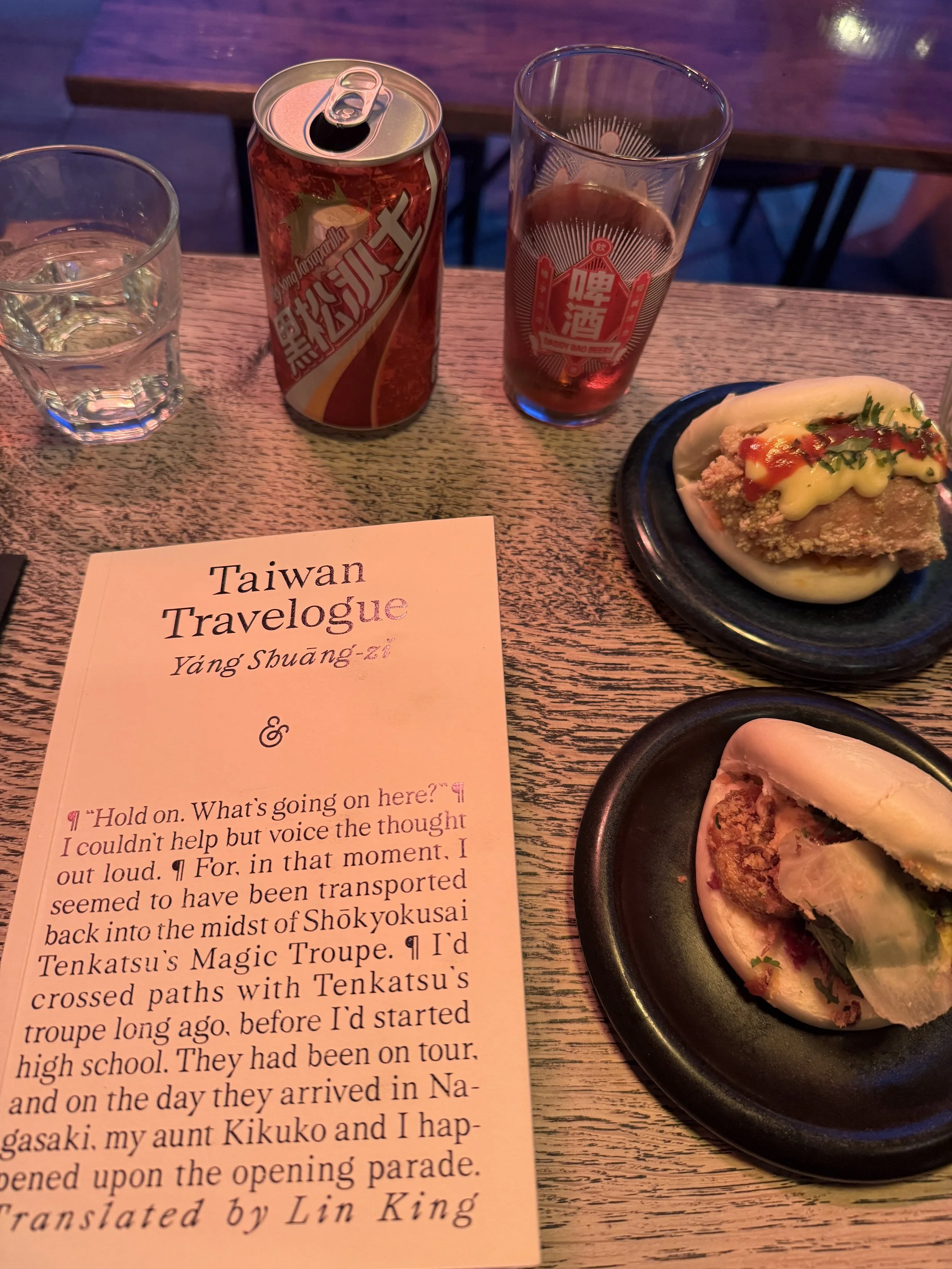
Not every reader has connected with this book, and I understand some have found the prose a little too simple, but there's a layer of complexity built in how the story is presented: as if it were an actual novel written and published in the late 1930s that then passed through multiple translations, from Japanese into Mandarin and beyond, complete with footnotes from different translators across the decades who sometimes openly disagree with one another, especially as the book goes on. It's framed like a found document, tracing its own fictional history, including a detail about most surviving copies being lost in a fire, the book going out of print, being revived in a new edition altered for the political climate of its moment, then rediscovered again later. That gives a real sense of books as fragile, fallible physical objects that can be lost and transformed, especially through translation, and so much of this novel is really an interrogation of what translation actually does to a text: whether it's simply an approximation, or whether it can genuinely reach the truth of what's being conveyed, given how much cultural context can't always cross over directly. It's a question that applies to how we take in any information as it's always filtered through our own subjective point of view, but it takes on particular weight when it's happening between different nations and cultures.
Verdict
I found this a genuinely enjoyable read that left me with complex questions regarding power structures and the longterm effects of imperialism. At the same time the actual experience of reading it was pleasurable and, especially toward the end, quite emotional. I liked that the story takes place across the span of a year. It's also made me think about my own travel instincts, that familiar tourist impulse to want the "authentic" version of a place rather than a performed one, and what that impulse actually asks of the people who live there. I suspect I'll keep thinking about that the next time I travel.If you've read this book, I'd love to know what you thought of it, and whether it made you as hungry as it made me.
Since I read this novel earlier this year it went on to win the 2026 International Booker Prize: https://www.youtube.com/watch?v=BvTU6FVos9c