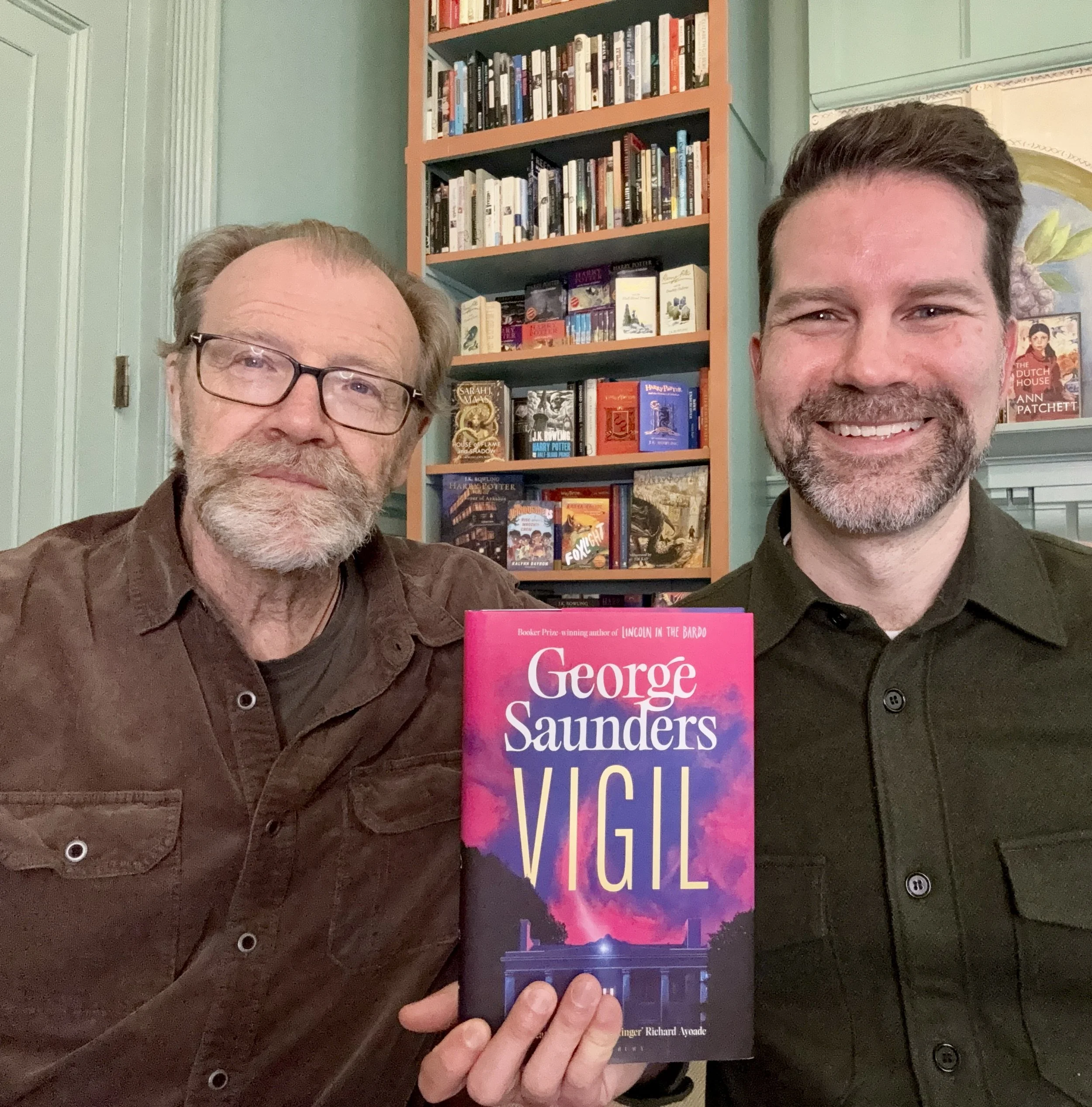
When George Saunders' first novel “Lincoln in the Bardo” came out in 2017 I instantly fell in love with it and was thrilled to see it win that year's Booker Prize. So I've been highly anticipating this new book and it was a thrill to interview him about “Vigil” in London: https://www.youtube.com/watch?v=-xyuMp5X7uM It's impressive that Saunders has such a towering literary reputation given this is only his second novel though, of course, he's also published multiple acclaimed short story collections and non-fiction as well as being very active in the reading community with different organisations and his 'Story Club' substack.
I found it somewhat surprising at first that, like his previous novel, “Vigil” follows a similar format where the narrative treads between the living and the very chatty dead. In addition to the dying protagonist/wealthy oil man KJ Boone, we're introduced to many idiosyncratic (and sometimes flatulent) individuals caught in a realm like the bardo, a state between living and rebirth that comes from Tibetan Buddhism. There are references to how these figures aren't ready to “move on” yet because of some unfinished Earthly business. However, the heroine of this novel Jill 'Doll' Blaine is in a state of “elevation” where she continuously returns to Earth to comfort those who are passing. I enjoyed the creativity, inventiveness and humour of how Saunders describes the way in which the dead act. But I'm aware that this sort of action can quickly slide into the puerile and feel flippant. I felt Saunders mostly kept to the right side of this as I was consistently entertained and surprised by the ghosts' actions. There's also a tragi-comic element to all the ghosts encountered as many are caught up in their own obsessions and unable to break free or find peace. To be caught in such an egotistical loop is its own kind of hell!
It feels timely that this novel focuses on a businessman whose decisions and unconscionable actions have led to so many painful deaths and the destruction of the environment. I'm sure many people are frustrated that a small group of powerful elite in this world find ways to work around the law and use their influence purely to enhance their personal wealth/status to such ridiculous proportions. So I'm sympathetic with this novel's central drive to hold such a man to account and confront him with the destructive effects of his decisions by surrounding him with ghosts. Through all his self-justification and denial, some small hidden part of KJ Boone knows that what he has done is wrong. The spirits which surround him appeal for him to acknowledge this but KJ is on the brink of death. Is an acknowledgement of this truth enough even though there is nothing he can tangibly do to correct his wrongs? What form of repentance is suitable for someone who has caused such destruction? Is it right to hold KJ Boone responsible when he's merely part of a capitalist and social system that encourages individuals to pursue enterprise without a conscience? This story raises these questions and many more.
I don't think these questions have any easy answers but the story interrogates these issues through the ghosts, some of whom are former colleagues to the dying man who take radically different positions. Their designs upon KJ Boone seem wrapped up in their own logic and understanding about whether humanity should be sought in those who act in an inhumane way. The Frenchman feels: “To comfort one who remains wilfully ignorant of what he has done is to provide no comfort at all, he said. If you truly wish to comfort him, bring him to admit his sin, then repent of it.” Of course, the most insistent voice we're closely aligned with in the story is Jill Blaine who merely wants to give KJ Boone comfort as he passes over into death. Naturally her intentions seem angelic, but her reasoning behind this is complicated by discoveries about her own past. Her killer Paul Bowman who unintentionally blew her up when he was targeting her husband has entirely forgotten about his crime and her beloved husband started another family shortly after Jill's death. As her short life has almost entirely been forgotten it seems natural that Jill wants to leave behind any sense of selfhood and devote herself instead to what she believes to be her mission in a state of elevation: “Elevation was true. It was. For sure. Me, elevated? Was real. Realer by a mile, at this point, than “Jill 'Doll' Blaine.” Nevertheless, she keeps being drawn back to her memories through the wedding taking place next door and her own investigations into the physical landscape of her former life. Though a state of elevation is her new reality it doesn't provide any solution to the dilemma regarding KJ Boone's guilt beyond offering an all-encompassing benevolence which is offered to anyone merely because they are human.
I felt Jill was a tragic character who I was highly sympathetic towards but I don't agree with her logic and I think Saunders is interrogating her reasoning as well. At the same time, I don't think there's necessarily any other alternative or solution about how to resolve KJ Boone's fate. I want to see him held accountable but I don't agree that anyone should be doomed or subjected to torture for eternity like a comic-grotesque duo known as the two Mels' want to inflict upon KJ. I think the novel itself bypasses offering any solution and instead we follow Jill as she's about to embark on another mission to provide comfort to someone who is dying. Instead of this being an admirable state of benevolence I think Saunders is suggesting that it's another kind of loop her spirit is caught within and a fate that she's subjecting herself to for eternity. Surely if more and more people like KJ Boone negatively impact the world in the destructive ways that he has done there will come a time in the future when no dying humans are left to comfort because humanity will have been wiped out. So the dilemma that Saunders presents in this novel is very dark and sombre.
I think this is a very creative and thought-provoking book, but its brevity made it feel less impactful and meaningful to me than “Lincoln in the Bardo”. I know it's perhaps unfair that this new novel should continuously be compared to the last. But the ending of “Vigil” felt somewhat rushed and Jill's supernatural intervention a bit forced. Nevertheless, I enjoyed reading it and the experience was naturally enhanced by discussing it with Saunders himself. It was interesting that he acknowledged at the beginning of our talk that reviews have been “all over the place.” A review in the NY Times calls this novel “a hot-water bottle in print form” and the Guardian commented that Saunders' writing is “starting to feel like a gimmick” with a familiar “repertoire of tricks and tics.” Meanwhile a piece in the LA Review of Books comments “the novel sometimes feels weightless, even frivolous.” Since he mentioned reviews of his book, I was tempted (but too shy) to ask Saunders if he felt that any of the criticism being made about it was reasonable and made him rethink how he wrote it. It's difficult to see where his fiction might go from here and I wonder if he is more of a natural short story writer than a novelist, but I always find it writing extremely creative and thought-provoking.