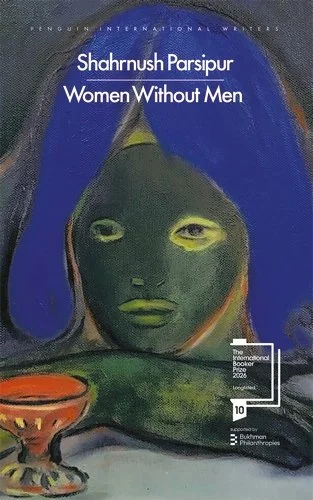
Although “Women Without Men” was first published in Persian in 1989 and translated into English in 2011 it wasn't published in the UK until recently by Penguin's International Writers series. It's wonderful that it's become more widely available as this is a modern classic which incorporates magical realism and feminism to convey the story of five Iranian women seeking independence from the patriarchy. The first chapter ends with the line “It is always the heart's desire that drives one insane.” I think this is the key to understanding how the repression which these women from different levels of society experience drives them to radically break free from the circumstances of their reality. The story follows as these very distinct women use different methods to obtain independence whether that be literally becoming part of nature or scheming to evade the control of men. It's a work of great imagination that is a testament to the creativity and resilience of the human spirit.
Shahrnush Parsipur is an Iranian-born writer who just recently turned 80. While living in Iran she was an advocate of free speech and under the Islamic government she was imprisoned for many years. She's written about these experiences in a memoir called “Kissing the Sword” which I'd also like to read. Parsipur was jailed again specifically for the content of “Women Without Men” because of its frank portrayal of female sexuality and it's still officially banned in Iran. This title is a novella which rotates between the perspectives of five different women who converge on a property with a vast garden and orchard. It's set in 1953 which is significant as this was the year in which a US and UK backed coup d'etat overthrew the democratic government to reinstate a monarchy which was more favourable for Western interests. Prior to this women were gradually being granted more rights within Iran, but with this change in government that was hindered by years of disruption which eventually led to the Iranian Revolution and an Islamic Republic. The historical events of this year don't play a direct role in the story, but there are references to the severe disruption and violence which is taking place outside.
The stories of these women mostly take place within domestic spaces where they come into conflict with each other and the domineering men in their lives. There is an emphasis placed upon whether or not different women are virgins and stereotypes about menopause are made by one of their husbands. They long for financial and social freedom, education and a place where they can truly realise their desires. It's so interesting how some of the women liken themselves to film stars including Julie Andrews and Vivien Leigh. Mrs Farrokhlaqa's husband thinks his wife resembles Vivien Leigh and it feels apt that she is inspired by Scarlett O'Hara because this was a character determined to forge her own destiny and survive no matter what it took. I felt one of the most striking characters is Munis who longs to understand her own body, but has been prevented from learning about female anatomy and sex. Her friend Fa'iza diminishes Munis and schemes to become romantically involved with Munis' brother. This relationship plays out in an entertaining way and it's engaging how all of the women in this novella embark on journeys of discovery. It's extremely imaginative how this breaks with reality in various ways where a woman turns into tree, a woman rises from the dead multiple times, a woman can read minds and another woman only sees men who are headless. These surreal occurrences grant freedom which can't be obtained in ordinary reality, but it's far from fanciful. There are also many realistic horrors depicted in this story including domestic violence, rape and murder.
So when the various women in this tale arrive at a point to live in a vast garden owned by the now financially independent Farrokhlaqa there is finally the wonderful possibility for them to control their own destinies. But this isn't a utopian space. The women disagree, some progress onto elevated states of existence while other regress back into more subservient roles within the patriarchy. However, the vital thing is that they are allowed to decide the direction of their lives for themselves rather than having their choices controlled. So it's very touching how we follow the fates of each of these complex and passionate women. While I admire the extremely creative way that Parsipur evokes their stories and created a kind of modern myth, I did feel that some of the accounts of their lives were too brief. Also, some scenes felt more cartoonish than fantastical. There's a section where a number of characters come upon murder scene and faint. When they wake up they've forgotten what they witnessed or dismiss what they saw as a dream which felt a bit too convenient. There are also some peripheral characters such as a maid whose story is cut off when the novella suggests it would continue. Nevertheless, this is such a striking and significant book which captures the stories of ordinary Iranian women in an impactful and memorable way. It's inspired me to read more about Iranian history, want to see the film adaptation of this novella and to read more by Shahrnush Parsipur.
This novel is currently listed for the 2026 International Booker Prize.