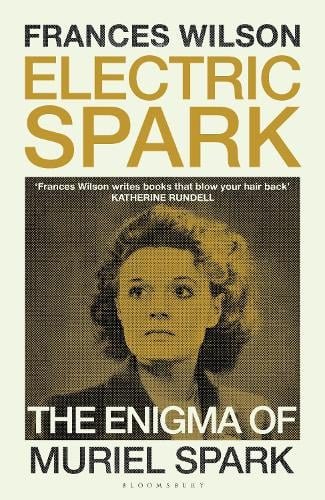
“Electric Spark: The Enigma of Muriel Spark” by Frances Wilson was recently shortlisted for the Baillie Gifford Prize for Non-Fiction but missed out on the trophy (which went to Helen Garner's published diaries.) This book felt extremely promising as it primarily focuses on the dramatic and varied events of Spark's early life leading to her impressive career as a novelist. Certainly Spark had an interesting life (writer, editor, critic, Jewish Gentile, Catholic convert, divorcee, mother and probably a spy) and she went through many transformations. However, I frequently found the compelling events of her life swallowed up by Frances Wilson's digressions, some of the critical analysis of Spark's novels, the convolutions of infighting between literary circles who have now been mostly forgotten and a preoccupation with the difficulty of writing a biography about an author who already published a memoir and who was the subject of other biographies (which Spark denounced.) It's understandable that Frances Wilson wrote about these things but the way she went about it frequently confused me. Writing about Spark is a considerable challenge – especially given that Spark seemingly wanted her life to be well documented but she also did not want to be criticised or subjected to scrutiny.
A review of this book in the Washington Independent summarised Spark's attitude well: “she wanted accolades rather than critical evaluation of either her life or her work... The author comes alive in these pages as self-absorbed, self-aggrandizing, self-mythologizing, and hypersensitive to slight. Like Miss Brodie, Spark is a fascinating, unsympathetic character whose wounding arrogance covers vulnerability. Her fraught and disappointing relationships often end with perceived betrayal. Family bonds are only distant background. Episodes of mental distress approaching psychosis seem exacerbated rather than helped by the treatment of the day. Given Spark’s many difficulties, her prolific literary output is even more remarkable.” In regards to the later point, I think Frances Wilson gave a good sense of Spark's intense discipline creating working environments for herself where she was disturbed as little as possible and this seems to be what ensured she could write so many books despite the multitude of personal problems she faced.
A big issue I had with the book was the framing device Frances Wilson chose with the four different historical women named Mary who influenced Spark in different ways. It seems a somewhat random choice given that Mary is a very common name. I guess Wilson chose this as a way of describing how different figures fed into Spark's creative imagination and gave support to the many coincidences strewn throughout Spark's life. However, the biographical bits about these different Marys felt more like a distraction. Certainly they are interesting in themselves, but often don't have much to do with illuminating the actual events or career of the primary subject of this biography. I felt there were also digressions which go into a bit too much detail about some additional literary figures and people Spark knew in real life. This caused Wilson to frequently jump backwards and forwards in time which left me longing for a more straightforward account of Spark's life. Funnily enough, I felt the biography was more coherent and at its most successful in the pages of its Afterward as it briefly describes the bulk of Spark's professional and later life – as well as the peculiar difficulties of writing a biography about Spark. Frances Wilson conveys information about the events in Spark's life and the sequence of her publications in a much more straightforward way in this final section (rather than weaving them through her elaborate frame of Spark's influences.)
There were some other sections of the main text that I also found impactful. For instance, I was compelled by Spark's life in Rhodesia (her disastrous marriage, the pain of having custody of her son given to her mentally unstable husband, the suffocatingly racist colonial atmosphere of the place at that time and the connection she found with Doris Lessing's fiction.) The emotional rift between Spark and her son which continued throughout their lives was especially sad. Spark's professional difficulties in the Poetry Society which was rife with misogyny made me angry that she had to deal with that. Also it was intriguing to learn about Spark's time working to generate propaganda during the war to confuse the enemy. There's a whole history behind this I'd like to learn more about but it also sheds light on the way Spark often seemed to be writing in code within her novels. There's a tension between appearances and truth which is frequently explored in her fiction. I felt knowing about this professional aspect of her life alongside what seemed to be an inherent paranoia and need to control gave a good sense about why Spark wrote in her own unique style. It was also interesting to learn how she began as a poet and thought of her novels as kinds of poems which also gives a sense for why she used language and imagery in the way she did throughout her fiction.
Something else I found discomfiting was a quasi-mystical idea running throughout the book that Spark seemed to possess some special powers of predicting the future or that what she wrote would eventually come to pass. I guess she had this aura or maybe she created it herself and maybe there were a number of coincidences in her life. But I felt like Frances Wilson bought into this eerie idea and tried to support it through numerous examples of Spark playing matchmaker or writing about something in a story which then actually happened. This almost supernatural sense about Spark's abilities felt alienating to me and made me question the validity of Wilson's point of view. I much preferred the descriptions of certain moments which felt significant in Spark's life like spontaneously staying at a poet's house for a night and how perusing the contents of that abode strangely inspired her.
Part of me feels interested in reading Spark's own memoir or Martin Stannard's biography about her, but knowing about all the gaps Spark left in her account and the objections she had about Stannard's take makes me hesitant to enter into the full mess of trying to understand her further. Frances Wilson must have felt compelled to structure this biography of Spark in a unique way to help navigate through the mire of Spark's considerable records and other biographical accounts. However, I felt the technique she's employed has hindered casual readers from more easily accessing the meaning and impact of Spark's life and her work as a writer. So I'm more compelled to just read Spark's fiction itself.
Alongside this biography, I really enjoyed reading “The Girls of Slender Means” for the first time which creates such an intriguing atmosphere of dread (as well as often being humorous) and it has a thrilling ending. I also recently read “A Far Cry From Kensington” which has a dark twist to it as it skewers the publishing industry and investigates a character being anonymously harassed. If this novel came out today Spark's representation of body image would be severely questioned but having read the biography and knowing Spark went through periods of being heavier and thinner it's easy to see how she filtered this into the narrator's point of view. I'm eager to read more of Spark's novels. My favourite book by Spark continues to be “Momento Mori”. However, I also really admire “The Prime of Miss Jean Brodie”, “The Public Image” and “The Driver's Seat”. I actually read “The Finishing School” when it came out in 2004 and unfortunately I thought it was terrible but it might be interesting to revisit knowing more about Spark now. I also went to see her talk about this novel at the time but unfortunately I don't remember anything about her interview since it was so long ago.
Writing a biography must be extremely difficult so I sympathise with the challenge Frances Wilson took on creating an account of Spark's life, but I'm afraid this approach didn't entirely work for me.