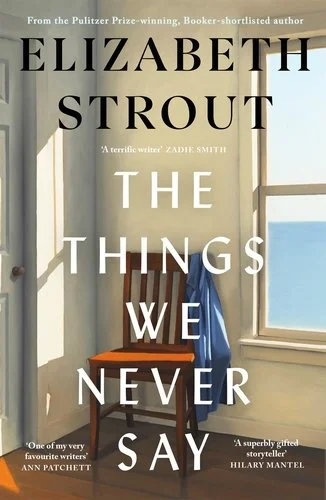
For the past several years Strout has created a beautiful tapestry of novels about the intersecting lives of a number of her characters – most notably Lucy Barton, Olive Kitteridge and Bob Burgess in titles such as “Oh William!”, “Lucy by the Sea” and “Tell Me Everything”. So it's notable that she has written a new novel which is entirely outside of this set of books – although keen readers will notice there is an easter egg within “The Things We Never Say” that refers to a previous Strout novel and definitively establishes that this story is entirely outside of that fictional universe. Though the setting and characters are somewhat different, Strout's characteristic style of fiction persists. We follow idiosyncratic characters having conversations and privately contemplating the world. The narrative dips into the past and gives small snapshots into the future. The author has such a moving way of representing her characters' thoughts where memories intrude upon the present to produce a ruminative and lightly philosophical sensation. The genius of Strout's writing is that it is both highly relatable and profound as it guides the reader through what matters the most.
This new story focuses on Artie Dam, a history teacher who lives on the coast of Massachusetts. He's been married to his wife Evie over thirty years, has an adult son and enjoys taking meditative solo afternoon sailing trips. And in this strange new post-pandemic world Artie finds himself preoccupied with a sense of loneliness and the question of whether we really have free will. Not only does he contemplate the possibility of incompatibilism but he boldly raises this issue in casual conversation. Naturally many people are quick to bat away discussing such a ponderous question. Gradually Artie finds truer understanding with the people in his life by daring to speak about things which aren't normally verbalised, but this isn't a sure method of achieving real connections. The results are both surprising and humbling as the story concerns the nuances of human communication. Sometimes his exchanges are tenderly moving and sometimes they're just awkward in a way which is true to the ebb and flow of our personal networks. Some friends turn into strangers and some strangers become close friends. The central father and son relationship in this story is especially poignant. There is also a narrative tension as Artie discovers a dramatic secret about his family which may or may not completely upend his life.
The novel begins in the lead up to the 2024 US presidential elections and Artie has a terrifying feeling about what the result will be. In a conversation it's remarked “He's going to win, you know... People want authority. They crave authority. And she doesn't have the kind they want, and he does. In his cult following kind of way.” Everyone who has lived through this recent period of time will know exactly what is being said here. Though Strout possesses a seemingly gentle style of storytelling this novel is also excoriating about the present state of the country and the very real threats we may face in the near future. It's no coincidence that Artie is a teacher of history and his class openly discusses the lives of ordinary people from the Civil War and WWII. The anger and frustration with the state of our present times is palpable in this story. Artie witnesses bursts of violence and firm political lines being drawn. Yet surprising love can also be found between people who are seemingly diametrically opposed. What can we talk about and what can't we say? At one point it's stated: “to say anything real was to say things that nobody wanted to know. Or if they wanted to know, they would not care in the right way. Or even understand. It was a private thing, to be alive.” Though Artie is preoccupied with the question of free will, Strout seems more concerned with the question: what's happened to decency?