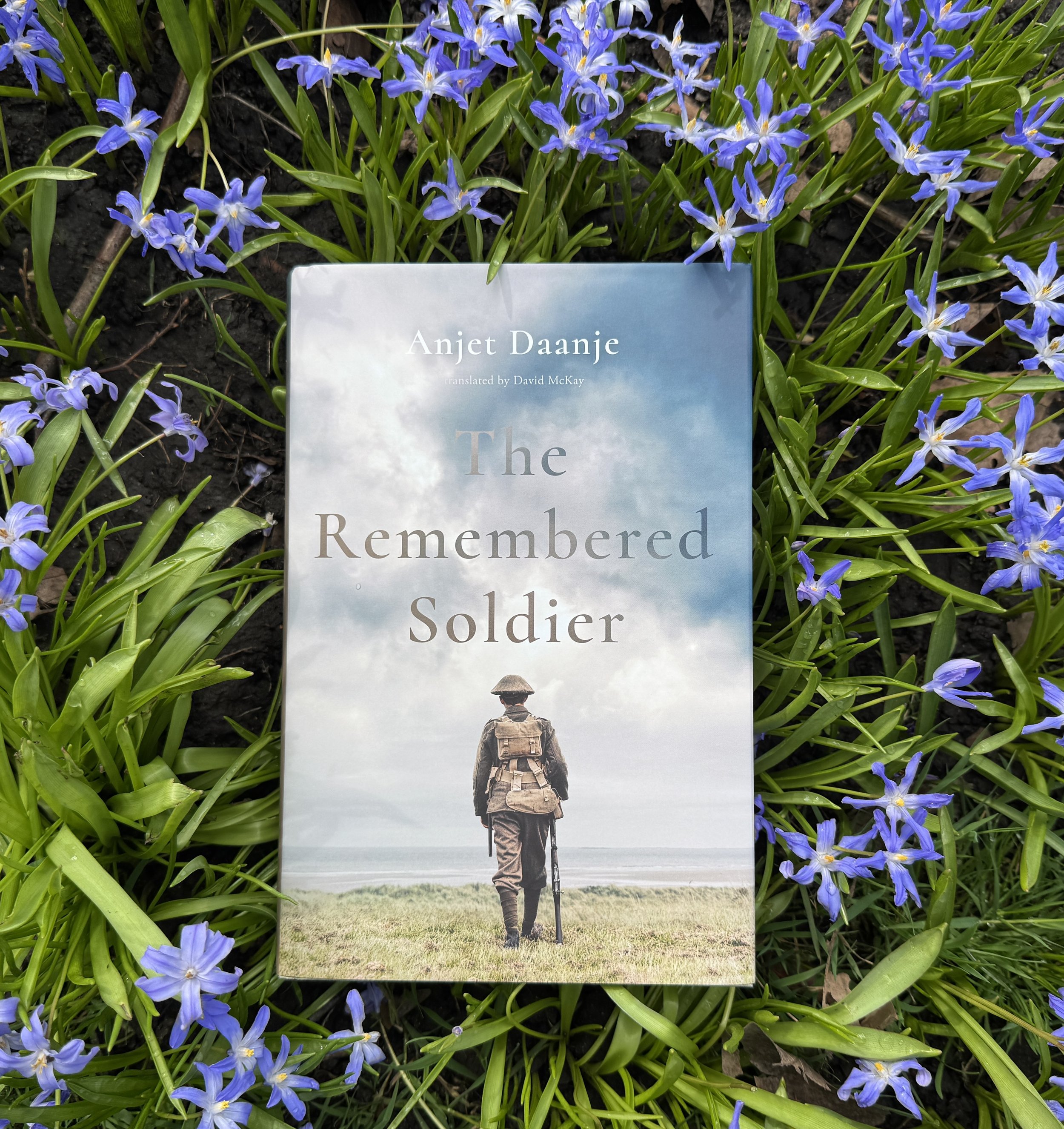
“The Remembered Soldier” by Anjet Daanje follows a WWI veteran nicknamed Noon who has lost his memory and resides in a Flanders asylum. It's fours years after the end of the war and a woman named Julienne comes to the facility claiming this veteran is her husband Amand. The novel traces this couple's story as they adjust to life together but there are questions about her motives amidst the debilitating effects of his shell shock. This is an emotional tale which took me a bit of time to ease into with the way it presents a cascading mountain of detail regarding Amand's psychological state and the dramatically fluctuating condition of his relationship to Julienne. But it feels so effective in conveying the horror of PTSD and the terrifying confusion from his amnesia. Moments of being fully present and aware come to feel so precious as his state of mind is often a blend of uncertain memories, nightmares, surreal fantasies and paranoia. The reader is also drawn into the tension about whether Amand is paranoid or is Julienne really hiding something about their past because of inconsistencies and questions regarding what she tells him. Daanje teases this out and, while I sometimes grew impatient with the way that Amand and Julienne's relationship ran hot and cold, I did feel very involved in their story. I wanted to know the truth about Amand's history, what Julienne is concealing and whether they'd be able to establish a stable and happy life.
I found it interesting that Noon or Amand seemed to be in a place of relative stability in the asylum with his routine gardening and his connection to some of the other patients, but of course there are terrifying undercurrents with the patients' nightmares and the time some former soldiers must spend in the ominously named “unruly pavilion” when things get too bad. The periodic pressure which comes from women who visit to see if Noon is their lost husband/relative seemed like another kind of needling agony as he's presented with so many possible lives to slot into until he's finally identified as Amand. It felt poignant when at one point in the story he returns to the asylum and finds he's outgrown it because he's established a place in Julienne's home. Yet he still sometimes longed for the tranquility he found in the asylum garden and this seemed to manifest in the way he occasionally walked out of the city until he found himself in a field.
Most notably, Daanje establishes an interesting form for the book where nearly every paragraph begins with the word “and”. The lines build into one long continuous extended description and the dialogue is compressed into the sentences. It gave me the sense of being swept into a river as we followed Amand's experience from being found by Julienne at the asylum to re-establishing himself in his family and work life. I think it's effective in conveying how there is barely ever any relief from the turmoil of Amand's condition as at any moment the ground beneath his feet might become unstable and he's be swept back into a nightmare. Are Amand and Julienne moving towards the truth or are they building an intricate illusion in their life together? At one point it's stated “he thinks she knows it too, their life is built on quicksand, one false step and they'll drown together.” This uncertainty builds a persistent sense of uneasy tension.
Amand comes to be wholly reliant on Julienne as “without her he has no idea who he's supposed to be.” He knows he can't trust his own mind and his memories are unknown but “there are also times he thinks it must be her, there's something about her, something unnameable.” There are several indicators of Julienne's potential untrustworthiness with how she concealed that she moved their family from Meenen while he was away at war, the question over their daughter Rose's parentage, how it's revealed Julienne used to be Amand's mother's maid, the way Julienne uses Amand to pose in photographs for financial gain and how their neighbour Felice accuses Julienne of falsifying her memories with Amand when the women have a fight. It's also so significant how Julienne spends much of her time retouching photos in an effort to both preserve and manipulate the past. However, there are plausible explanations for these things where Julienne might be tactfully withholding things or massaging the truth about the past to make their future together easier. It also might be that Amand finds it too difficult to accept a loving relationship after having lived in the dark about his life for so many years. It's remarked how “it's a safe world, this life he shares with her, but beneath it lies a nameless threat, whatever he does, thinks, says, it's there in the background, always, as if he glimpses it out of the corner of his eye and it moves again before he can look at it straight on, and the strange thing is somehow his fear always comes as a relief, his love for her was unknown territory, his fear is familiar.” Paradoxically there is a kind of comfort he finds in his fear rather than embracing the happiness which can be found with Julienne. But if the relationship turns out to be based on lies will that all collapse and he'll find himself in a new kind of horror?
Amand is also understandably wary about knowing the truth of his past and his time at war. It's remarked how “he's afraid for himself, for what his mind has managed to conceal from him all these years, it must be something terrible.” Yet there is no way for him to escape the past as memories might resurface unexpectedly and even amidst pleasurable experiences such as when the taste of chocolate reminds him of the chocolate he plundered from a dead soldier's pack while on the front. So he's trapped in a kind of limbo and this is poignantly symbolised in the way Amand and Julienne paint a backdrop of a no-man's-land for him to pose in front of to be photographed. Psychologically he's still there on the battlefield and can't escape it. And the widows who come to pose with him in front of that backdrop remind them of how many men didn't return from war. Though they know they are lucky and that finding each other was a “miracle” it's also fraught with so much difficulty, heartache and a tangle of complexity which might ensnare them.
I think it's masterful the way this novel presents an untrustworthy point of view. Amand losing his memory because of PTSD serves as both a testament to the trauma caused by the experience of war and a narrative device to create a lot of tension and mystery throughout the story. It's very impactful the way the novel roots us in his experience where the sense of disorientation and paranoia reach such terrifying levels. Since the narrative is filled with a profusion of detail following his experience with the repetition of the word “and” it felt all the more terrifying when there is a gap in his memory about what's occurred in the present. Amand realises that he can't trust himself and Julienne realises that she's inevitably going to lose the man with whom she's built a familiar relationship and love over the past year. As much as I felt suspicious of Julienne I also grew increasingly anxious for her and their children because of Amand's unpredictability.
The narrative style shifts in such a marked way in the final section of the novel. It's so striking that this is when the story moves from the intense often claustrophobic environment of their household with its familiar routines to the chaos of the larger post-WWI world. I found it so powerful how the novel describes the degraded existence of the collapsed German nation with the hunger, hyper inflation and highly skilled people forced to perform unskilled labour to try to get food. I don't think I've read any other fiction that depicts this post-war environment so vividly. Part of me wishes that this section had been longer with less time spent on fluctuations Amand and Julienne's relationship. Walking through this devastated landscape is such a wake up call for Amand who learns that “the war is over for the people it never really touched” but everyone else's lives have been shattered and existence is a constant struggle.
One of the most poignant characters in the story is a black dog named Issie. It almost feels paradoxical that an animal would stand out more than the couple's own children. A frequent criticism I've seen of this book is how small a role the children play in Amand and Julienne's life. I felt this as well while reading the book but my assumption is that this was a period of time when many parents weren't heavily involved in the emotional lives of their children. Parenting is more a practical obligation. But also Amand and Julienne were so wrapped up in each other there seemed little space for them to care about anyone else.
I think it's so compelling how this story raises larger questions about our relationship to the personal and collective past. There are the alternate realities we build for ourselves because we can't cope with the actual reality, but what is the cost of denying or manipulating the truth? There are also many specific questions to consider relating to the story. Of course, one of the big ones is can we really trust Julienne? Knowing the full truth about her and her motives is something I don't think we can ever know because this story is entirely from Amand's perspective, but it's clear she's a passionate survivor. One of the reasons I'd like to reread this novel one day is to see if I feel differently about her now that I know the entirety of this novel's plot. Even after certain plot points are answered larger uncertainties remain and ambiguities which can be debated.
Overall, I think this is such an impressive and moving novel! I admire the way it presents a tantalising mystery and gives a different perspective on post-WWI. Though it's a historical novel it feels relevant to consider how the effects of war last much longer than whenever politicians declare that a conflict has ended. It's also so moving how this story meditates on the meaning of memory and how it functions as the basis of understanding ourselves and our relationships to other people. Do our photographs give an accurate representation of the past or do they idealise the past? Is love an early commitment made after a passionate affair or is it found in the familiar routines where the challenges of daily life must be faced together? Daanje's story has left me with these lingering questions which I keep thinking about and I'm grateful the novel offers such a unique perspective.