We're at the halfway point of 2026, so it's time to go through my favorite books of the year so far. I've read 64 books in total, but as always, it's not about the quantity of what you read — it's about the quality of the reading experience. Plenty of those 64 have been great, but these 10 in particular are the ones that have really stuck with me: I keep thinking back on them, they linger in my mind, and I keep recommending them to other people. You can also watch a video where I discuss all these books: https://www.youtube.com/watch?v=0535jLdmHA0
A Family Matter by Claire Lynch
This novel follows a fractured family across two timelines: a present-day thread in 2022 following a man named Heron who is struggling to tell his adult daughter Maggie that he has a terminal diagnosis, and a thread 40 years earlier following a young mother named Dawn who falls in love with another woman. The ending is so emotional it brings me to tears just thinking about it, and the pacing is so beautifully calibrated that I was gripped at the end of every chapter, desperate to know what happens next. It also raises a devastating piece of relatively recent history: in the 1980s, courts would routinely strip custody from mothers deemed "unfit" simply for being in a same-sex relationship, shattering families in the process. This novel deservedly won the Gold Prize at the Nero Book Awards.
Floodlines by Saleem Haddad
This sweeping family epic follows three estranged adult sisters in 2014 who are pulled back together to decide what to do with the legacy of their late father, one of Iraq's most famous artists. Each sister and the wider family — their mother, and one sister's son — are drawn so richly and distinctly that I can still recall them all clearly, and the novel is packed with dramatic, messy family-dinner-party energy alongside its meditation on art, politics, and Iraq's recent history. I also had the pleasure of interviewing Saleem Haddad at Hatchard's Bookshop, where he named The Waves by Virginia Woolf — my own favorite novel of all time — as one of his inspirations, which made the whole experience even more special.
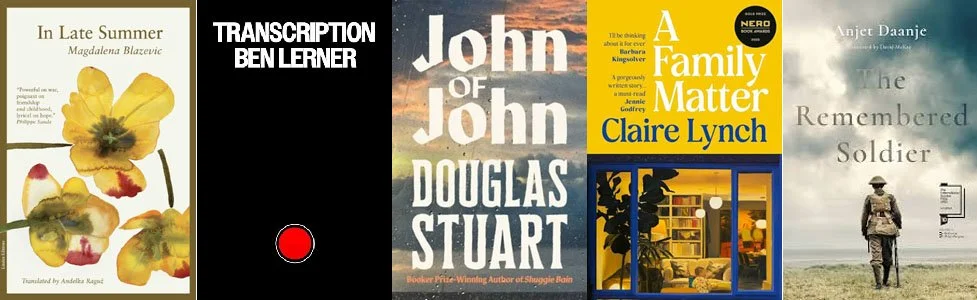
The Remembered Soldier by Anjet Daanje, translated by David McKay
Set in the aftermath of the First World War, this immersive novel follows a soldier who has lost his memory and Julienne, a woman who arrives at his hospital claiming he is her long-lost husband and takes him home with her. What follows is a rich, complex exploration of whether she's telling the truth, threaded through with real insight into memory, identity, and the lingering damage of war. A story about amnesia could easily tip into soap-opera territory, but there's nothing gimmicky here — I was completely gripped, and its exploration of love and romance under such strained circumstances is remarkably nuanced. I honestly couldn't believe this didn't make the International Booker Prize shortlist this year.
In Late Summer by Magdalena Blažević, translated by Anđelka Raguž
Set in the Bosnian countryside in the summer of 1993 as war sweeps through the region, this novel follows two adolescent girls and renders their daily lives with such poetic, evocative writing that it creates an overwhelming sense of place. It captures how the war gradually reshapes the individual, sensory lives of everyone in this village, and while the subject matter sounds like it would be relentlessly bleak, the writing instead gives real dignity and grace to ordinary people caught up in much larger events. The prose struck me as startlingly, piercingly beautiful — I found myself thinking of comparisons to Toni Morrison in how closely it ties environment, memory, and human relationships together. It was shortlisted for the Dublin Literary Award this year, and I think it deserves a much wider readership.
The Correspondent by Virginia Evans
This year's winner of the Women's Prize for Fiction — somewhat contentiously, though I was thrilled by the result — is told entirely in letters, and I fell head over heels for it. It follows Sybil Van Antwerp, a woman with a steely, reserved exterior but a real hunger to connect, and the novel slowly reveals the whole web of her relationships, including an unlikely, moving friendship with a struggling teenage boy. It took me a little while to adjust to the epistolary format, but once I was in, I couldn't put it down, especially as Sybil confronts a crisis point in her life while losing her sight. I loved all the literary references threaded through it too, since Sybil is a voracious reader who corresponds with a number of authors.
Dominion by Addie E. Citchens
This one really took me by surprise: set in a small Mississippi town, it follows the wife of a local reverend and a teenage girl who falls for the reverend's son, known as Wonderboy, with the dual perspectives slowly revealing who this young man really is. It's about the tense, evolving relationship between the two women at its center, and about stripping away the façade of the town's supposedly pious men. The structure — moving between the women's voices and documents establishing the town's history — is genuinely clever, and it shows how deeply religion is woven into the community and how that has constrained these women's lives in different ways. The writing throughout is sharp and precise; it's just a wonderfully clever book.
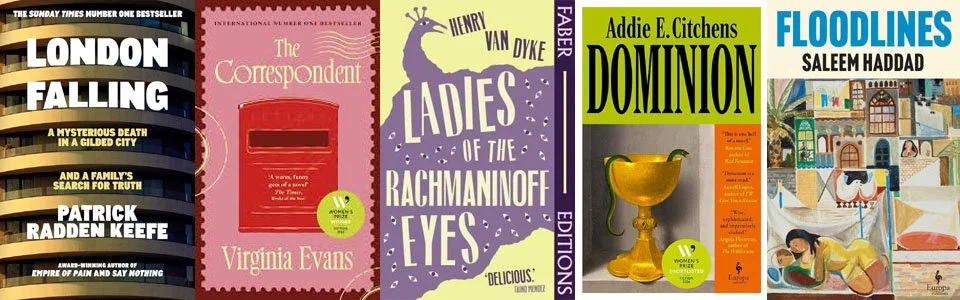
London Falling by Patrick Radden Keefe
This nonfiction book investigates the life and death of Zac Brettler, a teenage boy who was filmed falling from the balcony of a luxury London apartment complex and died in the Thames in 2019. Keefe traces how Zac got pulled into a murky criminal underworld, becoming increasingly unknown to his own family before his death, and the family's subsequent search to understand what actually happened to him. I read it at an increasing pace, desperate for more detail, and Keefe's research is as diligent and thorough as ever, raising genuinely intriguing questions about the case itself. It also becomes a wider lens on how commerce and politics have shaped London over decades.
Ladies of the Rachmaninoff Eyes by Henry Van Dyke
This reprint of a novel first published in 1965 was an amazing discovery for me, centered on Oliver, a teenage Black boy in Michigan living with his aunt and her close friend, a wealthy white Jewish woman who is also his patron and is funding his education. I loved following Oliver's precocious observation of these two women — who bicker and reconcile constantly, often fuelled by copious amounts of rum — especially once a charlatan medium arrives claiming he can contact the patroness's deceased son, and Oliver becomes determined to protect both women from being conned. Underneath the surface-level farce there's real feeling in how the novel explores Oliver's Blackness and his latent queerness. I had a particularly special experience with this one: I read the entire book aloud to my husband on a trip around Scotland, and it made me want to seek out much more of this author's work.
John of John by Douglas Stuart
So many people have been reading and loving this one, and rightly so — it's an emotionally complex story following a young man named Cal who returns to the remote Scottish island where he grew up, to his devoutly religious father John and his eccentric grandmother. The novel is steeped in the atmosphere of their daily work with textiles and sheep, and in a particular form of claustrophobia that comes from living in an isolated village where everyone knows everyone else's business, leaving little room for privacy or self-expression. It explores repressed desire and the real, tangible limits of living somewhere with so few options, and I got completely emotionally wrapped up in it. Visiting Scotland and seeing that coastline for myself afterward brought the novel back to life all over again.
Transcription by Ben Lerner
This is a short novel that packs in an enormous amount: it initially feels almost random, told in three distinct parts whose destination is genuinely surprising, but it all coalesces into something that left me with so much to think about regarding memory, technology, and how we live now. It opens with a man traveling to interview his 90-year-old mentor — a hugely respected intellectual figure — only to drop his phone in the sink before the interview, leaving him unable to record it. What follows explores how knowledge and ideas are actually passed down and altered across generations, rather than existing in some pure, unchanging form, all wrapped in an unexpectedly emotional story about fathers and their children. This deservedly won this year's Orwell Prize for Political Fiction.
A bonus mention: The Frenzy by Joyce Carol Oates
Before wrapping up, I have to mention Joyce Carol Oates' most recent short story collection, which is full of stories that are incredibly gripping and engaging. It was a genuine pleasure and honor to interview her about this collection — Joyce Carol Oates just turned 88 and is still so sharp, with so many ideas, that talking with her was truly inspiring.
Those are my favorite reads of 2026 so far — there's so much more to say about all of them. I'd love to hear if you've read any of these, if any of them have caught your interest, or what your own best reads of the year have been so far.