First Thoughts

“Departure(s)” is Julian Barnes's latest book and probably his last and I want to talk through my thoughts on it, because I didn't wholly love it. That said, I found it an extremely empathetic, moving, and wise meditation on life, love, memory, and writing — all subjects Barnes has returned to many times across his career. There's something almost ironic in calling it “Departure(s)”, since it isn't really a departure in subject matter at all. But these are huge, inexhaustible topics, and the way Barnes deepens his understanding of them here felt genuinely compelling to me.

Why "Departures"

The title works on a few levels. In the book, Barnes discusses being diagnosed with a form of blood cancer that isn't terminal, won't kill him outright, but is something he'll live with for the rest of his life, never fully defeating it until, as he wryly notes, he dies — at which point he supposes he'll have "won," except he'll be dead. It's also a departure from writing itself: he states plainly, on page nine, that this will be his last book.

The exact nature of this book is hard to pin down. I'd call it primarily a memoir, but it's also part essay and part novel, since at its center is the story of a couple, Jean and Stephen, and their particular, fascinating love story — one Barnes plays with our uncertainty over: is it true, or isn't it? He makes a wry joke about this hybrid form within the book itself, having Jean accuse the narrator (whom he names Julian) of writing these blended books when he should just pick fiction or nonfiction. Barnes's defence is that he knows exactly what he's doing, and it's true he's spent much of his career writing fiction wrapped in nonfiction, or the reverse, exploring memory, history, and the tension between subjective and objective truth.

Memory and Identity

The book opens with a fascinating psychological case: a condition called involuntary autobiographical memory, in which a specific sensory trigger, like the taste of cherries, floods someone with every memory of eating cherries across their entire life. Barnes wonders whether this might resolve the uncertainty of memory, letting us fully re-experience the past in detail, only to question whether that would actually be desirable at all, given how exhausting and how still fundamentally subjective it would remain. Other cases of vivid, detailed recall raise a similar problem: how could such memories ever really be verified?

This feeds into one of the book's central questions: what actually makes us who we are? Barnes opens by suggesting we are our memories, then complicates that immediately. If people lose their memories, as so many do with age, have they lost their essential self? Or is there something else, something to do with character, desire, and unfulfilled desire, that persists regardless?

Jean and Stephen

That question runs directly into the book's central love story. Barnes (as "Julian") met Jean and Stephen at Oxford in their early twenties and introduced them to each other; they fell into an intense relationship, then chose, as many couples do at that threshold moment after university, to end things and go their separate ways. Decades later, Barnes reconnected with both of them separately, discovered each had privately been thinking of the other all along, reintroduced them, and they married. It reads, at first, like a conventional happy ending, but that isn't where their story actually lands — old patterns resurface, and they've each lived entire, full lives apart from one another in the interim. Barnes gives the couple fictional names, explaining he'd once promised never to write about them, which only deepens the book's playful uncertainty about what's true and what's invented; he even challenges readers at points to go verify details themselves. But I don't think the factual status of Jean and Stephen is really the point. What matters is the shape of a love affair with a decades-long gap in the middle, echoing something Barnes notes people often experience late in life: vivid childhood memories resurfacing while the middle years blur and fade. A life with a hole in the center of it, made of what can't fully be known or recovered, and yet somehow still the substance of the whole thing.

A Writer Taking Stock

Barnes leans on other writers throughout, Proust especially, but also Flaubert and Woolf, quoting them frequently and acknowledging, with real self-deprecating humor, his own worry about repeating himself after so many books — he mentions fact-checking with scholars of his own work to make sure he isn't retelling the same anecdote again. There's a warm humor throughout in how he pokes fun at his own preoccupations, even while clearly still unable to move past them, because they're the questions that don't resolve.

It is a fairly brief book, and the love story at its center is handled somewhat lightly — I found myself wanting more detail there — but I think its brevity serves the larger meditation on time, personality, and understanding amid the general messiness of living. There's a genuinely somber undertone here too: an acknowledgment that Barnes and his generation of writers are dying out, with references to conversations with Martin Amis, who himself died not long after this book was likely finished. Barnes gives his reason for wanting to close out his writing life deliberately: not wanting to die mid-book and leave something unfinished, citing his friend Brian Moore, who did just that with his own final novel. And yet there's also real wit in how Barnes handles arriving at this stage of life, resisting some of the old-man clichés even while acknowledging others.

Is This Really His Last Book?

I'm not sure we should take Barnes fully at his word that this is his last book. He notes himself, cheekily, that we can and should trust novelists when they tell us the beautiful lies of their fiction, but that we're allowed real skepticism when they describe their own working methods. Other authors have announced a "final" book only to keep publishing. Whether or not this genuinely is his last, though, felt somewhat beside the point to me — what's here is a real, fascinating engagement with these enormous subjects, even if I found myself wishing he'd gone further with some of them. Though, of course, an 800-page final book might have undercut the whole project; there's real craft in how compressed and anecdotal this is, jumping between memories, digressions, and different writers while still cohering. Reading it felt like sitting across from Julian Barnes as he talked through his life, which is part of why I love spending time with older writers and hearing their particular slant on meaning.

A Personal Aside on The Sense of an Ending

Barnes has explored this same terrain, fiction blurring into fact, memory versus objective history, most famously in The Sense of an Ending”, his Booker Prize-winning novel. I reread it a few years ago, ahead of the new film adaptation, having first read it in my twenties, when it struck me as fairly thin. Rereading it in my forties, it hit me with far more force, and I found the story's exploration of a man's later-life reckoning with the unreliability of his own memory genuinely profound in a way it hadn't been the first time. I appreciated the film's own distinct take on it as well. That experience of a book changing meaning as you age with it feels like exactly the kind of thing Barnes is writing about in “Departure(s)”, and I suspect if I return to this new book in another ten or fifteen years, it'll land differently again.

Verdict

I'd love to hear from anyone who's read this: do you think it's really Barnes's last book, and do you think it ranks among his best? I hope it isn't his last, honestly, though we'll see. Whatever the case, this felt like a genuine celebration of literature and of the different ways we each read and are changed by the same books at different points in our lives — and it was a wonderful, if imperfect, experience to read.

Posted
AuthorEric Karl Anderson
CategoriesJulian Barnes

I always feel nervous when I hear that a great novel is being made into a film. It’s a risky business as I don’t want the pleasure of the reading experience soured if the movie is unfaithful to the characters and ideas of the book. However, some of my favourite novels such as Michael Cunningham’s “The Hours” and Christopher Isherwood’s “A Single Man” have artfully been made into very fine films. When I was invited to a preview screening of an adaptation of Julian Barnes’ “The Sense of an Ending” I was intrigued because I only vaguely remembered this book. I read it back in 2011 when it won the Booker Prize. However, the details of the story were sketchy in my mind – especially because it’s such a short novel. So I reread it last weekend and was newly astounded by the power of this book. It says so much about the way we perceive personal and social history, how the past can take an idealized form from endlessly retold anecdotes and how fallible identity can feel when lost details of the past re-emerge. I found it especially interesting going back to this novel after having read Barnes’ most recent novel “The Noise of Time” which looks at the question of history and free will under social pressures from a different angle.

The novel is broken up into two sections that are told from the perspective of Tony Webster. He recalls his teenage school days, an early relationship with an enigmatic young woman named Veronica and a friendship with earnest fellow student Adrian. His memories surrounding them are safely encased in a subjective understanding of the past. The first section of the book self consciously questions the meaning of history and how we perceive it by recounting debates that happened in his classroom. Adrian poses the theory that “History is that certainty produced at the point where the imperfections of memory meet the inadequacies of documentation.” This significant statement is repeated in the novel and plays out in the plot. Leaping forward in time, the novel’s second section shows Tony in his advanced middle age feeling secure in who he is and what happened in the past. But that’s all undone by his creeping uncertainty about his recollections and a missing document that was bequest to him. Suddenly his sense of self is crumbling amidst his attempts to reconnect with Veronica and desperately scrambling to understand the truth about the past.

Having just read the book, I felt wary about going to see this adaptation for two reasons. Firstly, it’s risky seeing a film straight after having read the book as it might feel dull seeing the same story played out on screen that you just experienced on paper. Secondly, because this novel is written from the perspective of an unreliable narrator, I couldn’t see how hazily remembered events could be shown in visual flashbacks without presenting them as what actually happened. Luckily, my worries proved to be totally unfounded because not only does the film of this novel faithfully interpret the story and overarching ideas of the book, but it made me think about the novel in a fascinating new way.

All the characters in Barnes’ novel feel slightly indistinct because you’re so embedded in Tony’s thought process. However, seeing these characters on-screen I could actually see how the actors added depth and complexity with subtle gestures and expressions. For instance, the character of Sarah (Veronica’s mother) played by Emily Mortimer comes across as much more energetic and flirtatious. Whereas Charlotte Rampling (who plays the elder version of Veronica) can switch her expression from steely to sinisterly amused with a slight twitch of her mouth. Similarly, seeing the elder version of the character of Tony performed by Jim Broadbent the viewer understands how prickly and unlikeable he appears. In the book, Tony came across to me as a slightly charming and benign presence. This is in sharp contrast to the younger version of Tony who is wonderfully played by Billy Howle who shows the character at a stage in his life when he was still a vulnerable and bolshy youth. Of course, these performances are giving an interpretation of the characters, but it made me think about the story and ideas of the book in an entirely different light.

The elder version of Tony recalls his past throughout various points in the movie and this elder version of himself gradually starts to actually enter this history. At other times actions are mirrored by the younger and older version of the character. This is done in a subtle way which adds emotional depth to Tony’s desperation to understand what actually happened and the pain of his nostalgia. Tony’s subjectivity is still reflected in the film because certain events play out in an ambiguous way. He’s never entirely sure the meaning of what some people said to him or the motives of their actions. This felt very true to life for me in the way that we endlessly mull over certain events of our life considering what happened from different angles until the facts themselves seem indistinct. It’s really moving in the film how Jim Broadbent shows Tony’s journey from a position of self-satisfied certainty and emotional-standoffishness to someone who is more sensitive to the ambiguities of his own past. The only element of the film which I didn’t feel worked as well was the slightly sentimental tone that the movie takes towards the end – something which felt crammed in to give a heart warming feel.

Overall, the filmmakers made a lot of clever choices and most text-to-film changes improved how the story worked visually. Also, there's a wonderful scene that takes place in Foyles on Charing Cross Road - always a treat for book lovers to see! After the screening I met with a group of book bloggers and writers to discuss how the film worked as a book adaptation. It was a really lively and interesting conversation as everyone was really engaged and excited by how well the book worked as a film. I was particularly struck by how the writer Isabel Costello mentioned how differently the novel affected her reading it a second time later in life. “The Sense of an Ending” is one of those novels which can be revisited continuously as it will take on a different resonance with accumulated experience. I think the same will be true for watching and re-watching this adaptation. It feels so rare that seeing the film of a great novel can actually enhance the reading experience, but the new movie of ‘The Sense of an Ending’ accomplishes this beautifully and made me eager to read this profound book again.

Posted
AuthorEric Karl Anderson
CategoriesJulian Barnes
7 CommentsPost a comment

In 1936 a Russian man spends night after night sitting by the elevator of his building fully expecting to be taken away to be killed. Dmitri Dmitrievich is a successful composer whose work has been judged by an editorial as contravening the ideals of the Soviet Union. He wants to avoid trouble for his wife and young daughter who sleep nearby so waits outside his door with a packed suitcase. He’s made to live in a perpetual state of terror expecting secret police to seize him at any minute. Over years of intense scrutiny and being batted around by the ruling political powers, his immense talent and passion for his music is slowly twisted. It provokes questions about the meaning and value of art when it’s trampled on by the overriding political forces it’s created under. The novel is composed in triptych form capturing Dmitri’s feelings at three very different points of his life. Spaced in twelve year intervals it also makes a fascinating portrait of the Soviet Union at significantly different stages of its existence. Inspired by the real-life Russian composer Shastakovich, “The Noise of Time” asks how the pure intentions of music fare when played against the clamorous dogma of reigning ideologies.

One of the great challenges of reading any novel set in Russia is trying to keep track and comprehend the flurry of names which appear. Many people have triple-barrel names, each of which is intermittently used and sometimes variations of those names are used in place of the proper names. This simply poses a practical problem for a reader, but I’ve never found it really detracts from my enjoyment of a novel – especially when it’s as powerful and elegantly told as this one. My strategy is to keep a list of the primary characters while reading and, after a time, the story washes over me to a point where I know who is who. Another challenge is entering into Soviet Russia’s complex and extensive history of which I only have a bare bones understanding. I didn’t find this to be a problem though as long as you have a broad understanding of Communist Russian and Stalin’s life – who plays an integral part in the story. Really this is a novel about the fate of artists under the rule of tyrants. Its universal meaning can be strongly felt even if you don’t get some of the nuances of the world in which it is historically set.

Normal
0


false
false
false


MicrosoftInternetExplorer4


 /* Style Definitions */
 table.MsoNormalTable
	{mso-style-name:"Table Normal";
	mso-tstyle-rowband-size:0;
	mso-tstyle-colband-size:0;
	mso-style-noshow:yes;
	mso-style…

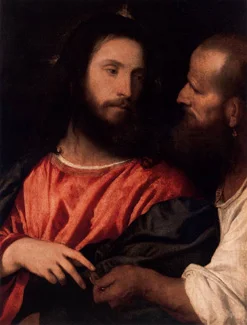
Dmitrievich keeps on his bedside table a postcard of The Tribute Money by Titian – painting where the Romans try to bribe Christ for their own political motives.

One of the most fascinating sections is when Dmitri goes on a state-approved tour of America. He’s much lauded in other nations even if some of his work is still banned in his own country. The Soviet Union try to use him as a pawn to present their country as less oppressive and more open. But the effect of this ultimately fails: “Scrub, scrub, scrub, let’s wash away all this old Russianness and paint a shiny new Sovietness on top. But it never worked – the paint began to flake off almost as soon as it was applied. To be Russian was to be pessimistic; to be Soviet was to be optimistic.” Instead of being inspired by the “freedoms” supposedly found in the US and other western nations, Dmitri feels how they are both played and play into political forces which seek to suppress opposition to their power. He also hilariously notes about American journalists that “The fact that they couldn’t pronounce your name was your name’s fault, not theirs.” There is also quite a funny perspective given of the thinness of Picasso’s political convictions: “he knew Picasso for a bastard and a coward. How easy it was to be a Communist when you weren’t living under Communism!” Dmitri eventually finds himself unstoppably drawn into a system whichapplauds him as an idol for their own purposes “He swam in honours like a shrimp in shrimp-cocktail sauce” rather than an artist with an independent voice and spirit.

This novel made me question the degree to which my own creativity is guided under the society in which I live. Even if I don’t live within a country that seeks to directly shackle what’s created within its own dominant ideological beliefs, I’m guided and influenced by the media and popular beliefs of those around me. In this novel it’s observed how even good intentioned people are worn down by the fact of their survival because “conscience was always there to insist that more courage could have been shown.” Barnes explores the deep complexities and moral ambiguities involved in a lifetime under an oppressive regime. What survives through the gruelling circumstances under which it is created is the music: “Art is the whisper of history, heard above the noise of time.” But the novel asks how this might become perverted when the mind of the artist has been poisoned by a lifetime of compromise. “The Noise of Time” is a short intense novel of breathtaking scope and wisdom.

Listen to a wonderful interview with Julian Barnes by Sinéad Gleeson on The Book Show where they discuss “The Noise of Time”, the author’s bookshelf and his development as a writer: https://soundcloud.com/thebookshow/the-book-show-s3-1-16th-january-2016-at-home-with-julian-barnes

Posted
AuthorEric Karl Anderson
CategoriesJulian Barnes