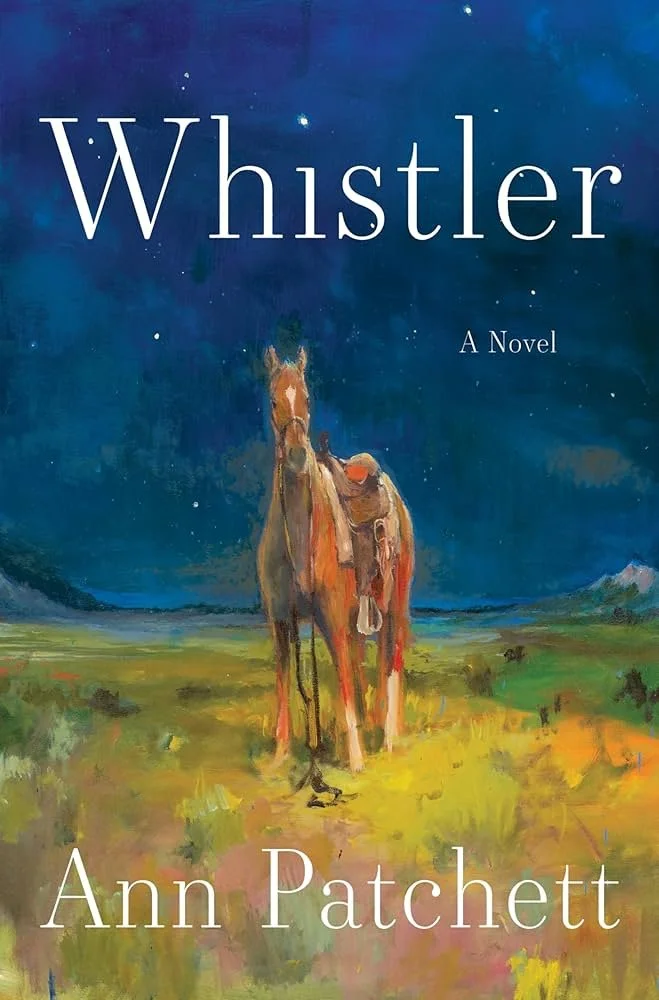
The world has felt quite heavy lately, and I've come to treasure the kind of novel I can turn to for solace in such times. Not a slight or simplistic book, but a quiet one: contemplative and reflective, where nothing too dramatic or tragic occurs, yet which looks at identity, memory and relationships in a genuinely engaging way. Ann Patchett's tenth novel "Whistler" is a perfect example of this, and I read it recently as a great comfort. It's written in a way that feels so straightforward and relatable — the language and structure never overly complex — that I connected with it immediately. I also discussed it at length with my book club recently, where it divided readers more than I'd anticipated, and those conversations only deepened my appreciation of what Patchett is doing here.
The story follows Daphne Fuller, a teacher of fifty-three who is recognised at the Metropolitan Museum of Art by Eddie Triplett, her former stepfather, whom she hasn't seen in nearly forty-five years. Eddie was married to Daphne's mother Abigail for little more than a year, and the marriage ended abruptly after a car accident on a snowy road when Daphne was nine. What struck me, and what I think is the beating heart of the book, is the wonderful instant rapport the two of them rediscover — a connection that lets Patchett explore familial relationships and the question of what actually makes a parent in a really interesting way. Daphne has had three fathers across her life, and the novel is quietly insistent that the man who was present for barely a year might be the one whose heart was, as she puts it, forever stitched to hers.
Much of the pleasure lies in watching Daphne negotiate the tender and sometimes tricky relationships around her. She has a lovely, easy rapport with her sister Leda, a clinical psychologist who draws the buried story out of her, while her bond with her mother is more complex. I found Abigail especially well drawn: steely on the surface, unlucky in love across three very different marriages, yet someone I came to feel real sympathy for once I saw what she'd done in raising four children through difficult circumstances. As a counterpoint there's Daphne's marriage to Jonathan, an easy-going and mutually supportive partnership that still has its own small points of tension. The way Patchett handles all these evolving histories — who knew what, who's only learning it now — felt so recognisable and was, to my mind, beautifully done.
Structurally, the novel keeps circling back to that night in the overturned car, and we only gradually get the complete picture of how Eddie and Daphne survived. I loved the gentle tension this created; I kept wondering how they physically came through it. The crisis itself arises from Eddie's folly in switching off the headlights so the two of them could better see the stars, and I completely understood the impulse — one of the most transcendent experiences of my own life was being in a desert in the middle of the night beneath a canopy of sky so piercingly beautiful it hardly seemed real. It's there in the freezing car that Eddie tells Daphne the story of a woman named Mary Carter and her horse, Whistler, to distract her from their peril. The tale is sentimental, and I did wonder about the plausibility of it being something Eddie would later be so keen to see published, yet it carries real symbolic weight, threading survival, mortality and human connection through the whole book. The image of the horse recurs beautifully, too — in the granite carving at the Met, where Daphne sees "one horse and its ghost", and later in a toy horse Jonathan gives her.
That emphasis on stories told aloud is, for me, what elevates "Whistler" above mere comfort. A counterpoint to Mary's story comes when Daphne, sitting with Eddie through his treatment, tells him about the death of her biological father Buddy Zabriskie — a heartbreaking account, but also a beautiful way of honouring a largely absent parent in his final days and granting him a lifelong wish. (It's Buddy, after all, whose box of emergency provisions kept the two of them alive in the car all those years before.) I found it genuinely moving how these oral tales demonstrate the solace and reflection that storytelling can offer, especially in moments of crisis and heartache. And as a reader I confess to a geeky delight in how much the novel revels in a love of books: the woman at the party who prides herself on having read everything while Daphne tries to name novels she might have missed; the house full of unread Philip Roth that Daphne keeps meaning to begin; Eddie's small apartment lovingly crammed with books. It's an unabashed pleasure to spend time with characters who love reading as much as I do.
(Some spoilers follow in this paragraph.) What I found most quietly affecting was the gradual unfolding of Eddie's homosexuality and the complicated dynamics of his relationships. It felt entirely believable that he and Abigail would enter into a marriage naively trusting it would be enough, only to realise it wasn't — no malice in it, just varying degrees of self-deception, and a love that remained real even though it was never romantic. That it's all reflected upon in retrospect by both of them, while coming as new information to Daphne and Leda, makes it the more poignant (and I loved the touch of Leda's son clocking Eddie's sexuality long before the sisters did). Harder to parse is Eddie's lasting devotion to Skip, who, when we meet him in old age, seems rather distasteful. But I think the Eddie/Skip/Polly arrangement is finally unknowable to us, because we haven't lived everything these people have. This is a very different book from something like Patrick Ryan's "Buckeye", which shows us the formation of a marriage between a gay man and a straight woman from the inside; here the context and compromise sit mostly off the page. Patchett seems to be arguing for a degree of grace when we look at other people's lives — their relationships evidently work well enough for them, in their different ways, and it's all too easy to judge in hindsight.
As with "Tom Lake", I can see exactly why some readers grow impatient with a tale of relatively comfortable, you might say privileged, lives where little appears to be at stake — that was certainly the fault line in my book club, and it echoes the sharper critics who've found the book too neat or too nice. But I don't think the low stakes mean there's no drama. The drama is simply internal and interpersonal: the tensions playing out between characters, and Daphne's private reckoning with her past. For me that's precisely the territory I love in a quiet novel, and I'd place "Whistler" in the company of books like Anne Tyler's "Ladder of Years", Colm Tóibín's "Nora Webster" and Rónán Hession's "Leonard and Hungry Paul" — stories that cherish the aspects of life fiction too rarely values.
So much of this novel is tender, funny and hopeful, full of moments of true connection that I found simply beautiful. I'm glad Patchett has carved out this space in literature for calm, reflective, big-hearted fiction rather than reaching for high drama. "The Dutch House" remains my favourite of her books, but I'll gladly read anything she publishes, and I'll go on enjoying those video recommendations she shares from Parnassus Books. If you've read "Whistler", I'd love to know where you landed on it — did you buy wholeheartedly into Daphne and Eddie's connection, and did its quiet, low-plot structure feel confident or slack to you?