First Impressions
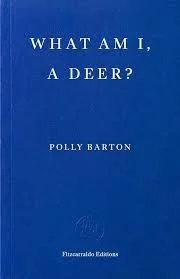
Most of us have, at some point, built an entire inner life around someone we barely know. Maybe it was a stranger glimpsed on the same commute every morning, or a person whose few words to us we replayed until they carried enormous weight. These fixations can feel embarrassing to admit, but they say so much about what we're lacking and what we long for. "What Am I, A Deer?" by Polly Barton is a slender novel that takes this very ordinary experience and turns it into something surprisingly moving and extremely thoughtful. I didn't expect a book this short to affect me so much, but it captures beautifully what it feels like to live a modern life: the work of breaking through our own insecurities and awkwardness to reach for some form of authenticity and true connection.
Tram Rides and the Umbrella Man
On the surface, the story is fairly simple. A young woman moves to Frankfurt to translate Japanese for a famous gaming company, despite having little interest in games. She's set on a kind of reinvention, but she finds herself caught in the familiar clutches of tedium and self-loathing on her morning commute. Then a nice-eyed stranger returns the umbrella she left behind on the tram, and she's catapulted into a year-long obsession with him. The novel calls him simply "umbrella man", and elsewhere the term "John King" stands in for any form of idealised man. These names are generic on purpose. What matters is less the man himself than the space he fills in her imagination.
So while this is partly a romance, a longing for an unobtainable crush, it's about much more than the messiness of sex and relationships. The novel ponders how our desires, whether professional, personal or romantic, become inextricably linked with wanting to fill the empty parts of our inner lives. I found this so perceptive. There's a real honesty in how the narrator recognises that what she craves isn't really this particular man, but a feeling of being fully present and alive that he seems to promise.
Karaoke as a Way of Being
I love that the novel begins with a memory of the narrator as a child wanting to become Celine Dion, performing a cappella in front of her classmates. It's such a tender scene because it captures that childhood urge to step fully into a bigger, braver version of yourself, however mortifying it might look to everyone else. (It also sent me down a rabbit hole of listening to Celine Dion songs.) This memory leads into how karaoke comes to represent an expression of her inner being as an adult. In dark, sweaty karaoke booths, her longings merge with the lyrics of emotionally charged songs, from Mis-Teeq's "Scandalous" to Fiona Apple's "I Want You to Love Me".
I really liked the way lyrics are interspersed through the story to round off the main character's feelings. Rather than feeling like a gimmick, this felt true to how many of us actually experience music: a song can articulate an emotion we're unable or unwilling to say aloud ourselves. Karaoke becomes a strangely poignant form of self-expression here, and a kind of solace that's both ecstatic and a little desperate.
Playing with Form
It's so sly how the opening section moves from the second person into the third person, which carries the bulk of the narrative. It happens so smoothly that the reader is drawn into the character's perspective before we fully notice the shift, and it subtly plays with the distance between the narrator and herself. As one of the judges of this year's Goldsmiths Prize, Francis Spufford, remarked, sometimes the frontier for innovation in the novel is an interior one. Barton finds a flowing, intricate and almost obsessive language for consciousness that extends the great modernist experiments in charting minds in motion.
The novel's title comes from Isabella Rossellini's series of "Green Porno" and "Seduce Me" videos about sex in the animal kingdom, and I enjoyed how Rossellini's quirky reflections are integrated into the story. The book opens with an epigraph from Catherine Lacey's "Biography of X", a novel I loved, alongside a lyric from Mis-Teeq, which feels like the perfect signal for what follows. There's a playful blend of high culture and academic theory with pop culture throughout, and this mix captures something essential about modern life, where we move between the profound and the throwaway every day and often find meaning in the unlikeliest places.
From Translator to Novelist
You might well have come across Polly Barton's name before, as she's the acclaimed translator of many Japanese novels, including Asako Yuzuki's hugely popular "Butter" and Saou Ichikawa's "Hunchback", which I read and which was listed for the International Booker Prize. She has also published two works of non-fiction, "Fifty Sounds" and "Porn: An Oral History". It's fascinating to see her craft her own fiction, and the novel's protagonist, a translator navigating life in another country and language, feels charged with insights about what it means to move between cultures and selves. "What Am I, A Deer?" is her debut novel, and it has been shortlisted for the 2026 Goldsmiths Prize.
Verdict
This is a thoughtful, sly and funny book about breaking through awkwardness to reach something authentic. It renders the paradoxes of modern life with real complexity while remaining deeply tender towards its heroine and her yearning. Of all the books on this year's Goldsmiths Prize shortlist, it was the one that most surprised me with how moving I found it.