First Impressions
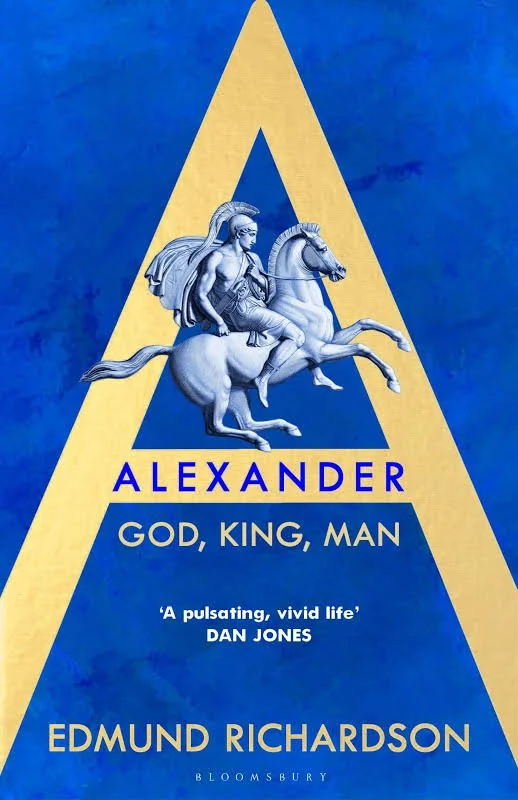
It feels startling that someone who died just short of his thirty-third birthday could have changed the world so completely, and yet that's the dizzying reality at the heart of Edmund Richardson's "Alexander: God, King, Man". This is such a compellingly told, imaginatively constructed and richly researched account of Alexander the Great, and it's no surprise to me that it has just won this year's Baillie Gifford Prize for Non-Fiction. It's the first book about ancient history ever to take the £50,000 award, beating a strong shortlist that included Patrick Radden Keefe's "London Falling", and the chair of judges, Kirsty Lang, praised how it "reads like a novel". It's so immersive how Richardson reimagines the bloody moments of war, the dramatic political conflicts and the transformation of Alexander's sense of self as he battles across the world through years of relentless conquest. Early on, he notes that almost 1 per cent of the world's population would die as a direct result of Alexander's campaign, and that sobering fact hangs over everything that follows.
From Penniless Prince to Living God
What I found most amazing is the sheer scale of Alexander's journey. When his father Philip II is assassinated, Alexander inherits a tumbledown kingdom, an empty treasury and millions of drachmas of debt his father had secretly run up. He is twenty years old, and few people have thought much about him at all. Within weeks of his first victory in Asia, he captures the treasury at Sardis and, as Richardson puts it, "the penniless young king was suddenly 'richer than Croesus'". By the end he has plundered the fabulous wealth of Susa and Persepolis, been crowned pharaoh in Egypt, made the gruelling trek across the desert to the oracle at Siwa, and come to be hailed as the son of a god. Richardson charts this not just as a series of conquests but as a psychological journey, and I found it fascinating to follow how the role he plays for others gradually becomes the person he believes he is.
The Company He Kept
I appreciated how the book shows that Alexander must have been highly intelligent. As a teenager he was tutored by Aristotle in an idyllic sanctuary in Mieza, learning to question who he was and to look for order behind chaos. Later, he kept a copy of "The Iliad" annotated by Aristotle in a jewelled box taken from Darius's baggage. But Alexander's victories also rested on the expertise of the people around him. There were veteran generals like Parmenio, and above all there was Diades, an engineer from Philip's specialist siege division. When Alexander is humiliated before the island city of Tyre, it's Diades who notices how shallow the seabed is and builds an enormous causeway out to the city, while the Tyrians row out in pleasure-boats to jeer at the soldiers hauling rocks. It emphasises how a smart leader will surround himself with smart people. That makes it all the more tragic to see what happens to those people later on.
"Get Out of My Sun": Diogenes
I was especially interested in how Diogenes figures in the story, because I'd only recently met him, in canine form, in Chloe Aridjis's novel "The Shadow of the Object". There, the family dog that bites Flora at the start of the novel is named Diogenes, a nod to the founder of Cynicism, who was nicknamed "the dog". Richardson's Diogenes is every bit as gloriously rude as his reputation. He lives in a wine jar, calls Plato "a waste of time", and responds to Plato's definition of man as a featherless biped by plucking a chicken and setting it loose in his lecture room. When the newly crowned Alexander comes across him in Corinth and asks what he can do for him, Diogenes snaps, "You can get out of my sun." Rather than being offended, Alexander is delighted by a man who seems to want nothing and care about no one, and he leaves insisting that if he were not Alexander, he would want to be Diogenes. Diogenes's influence also travels with the army. Onesicritus, the philosopher who travelled with the army and later wrote about Alexander, had studied with him, which leaves him poorly prepared for the even greater scorn of the naked holy men he meets in India, and Richardson quotes Diogenes explaining his nickname with "I bite people who deserve it". That's exactly the reading of the dog's bite that opens Aridjis's novel, a bite that strips away illusions. I loved this unexpected echo between the two books. There's something wonderfully pointed about the most powerful young man in the world being told to stop casting a shadow, by a philosopher who, famously, wandered Athens with a lamp in search of an honest man. That's a search Alexander's court of flatterers would have made very difficult indeed.
Myth, Then the Truth Underneath
It's so clever how Richardson presents this history, because he is constantly disentangling the true history from the myths. Sometimes he presents the legend first so that I could feel the full wonder of it, then pulls back to show what can really be known. The Gordian Knot is a perfect example. He builds the scene of Alexander straining with the hidden loops of cord while the crowd grows anxious, until he finally draws his sword and slashes through it. Then Richardson points out that there's no record of the wagon, the knot or the prophecy before Alexander arrived in the city, so the whole legend appears to have been cooked up to inspire his men. He also captures the excitement of archaeological discovery. This ranges from Manolis Andronikos's sensational 1977 excavation of the royal tombs at Aigai, and the doubts that later cracked his neat conclusions, to the remains of Greek mercenaries uncovered near the Granicus battlefield in 2024. He even uses computer code and satellite elevation data to hunt for the lost mountain fortress of Aornos.
A Hero Built from Homer
It's also so engaging how Richardson builds a sense of Alexander's ego and ambition. Alexander modelled himself on Achilles. At Troy, he and Hephaestion run naked around the tombs said to belong to Achilles and Patroclus, and he takes ancient armour from a temple there to carry into battle. By aligning himself with a mythological figure, he went on to build a myth of himself. Through his conquests and the stories that proliferated around him, Alexander became something like one of the world's first superstars, and his story has since been retold by everyone from Roman politicians to Ethiopian monks and Icelandic bards. There's real poignancy in the moment Alexander remembers telling Hephaestion that Achilles was fortunate to have the man he loved at his side and Homer to tell his story, by which point Alexander has lost both his beloved friend and his historian.
The Horror of War
I was also horrified by the terrifying violence Richardson describes. During the siege of Tyre, the Tyrians heat sand in giant bronze cauldrons until it glows, then catapult it onto Alexander's soldiers. It slips beneath their armour and sears their skin while they scream "like men being tortured". The same defenders hurl red-hot lumps of metal into the packed ranks and use giant nets to snatch men off the ground and dash them against the rocks. Alexander's own cruelty can be even worse. After the long siege of Gaza, he has its defiant commander Batis tied to the back of his chariot by the ankles and dragged around the city walls while still alive, in a savage imitation of Achilles dragging Hector's corpse. It's remarkable that Alexander survived as long as he did, given how often he fought at the front: his helmet was split by an axe at the Granicus, he was slashed across the thigh at Issus, and he was left with a wound at Gaza that stubbornly refused to heal.
I also found it compelling how Richardson draws on modern science to better understand Alexander's time. He describes how agent-based models, often used to predict the spread of disease, can recreate the army's march through the Gedrosian desert soldier by soldier and mule by mule. The simulation suggests the army's condition was even worse than the ancient sources let on: once the baggage animals began to die, mass casualties among the soldiers became almost inevitable. On top of that, a flash flood tore through the army's camp one night, sweeping away families, supplies and nearly every remaining animal. Richardson also brings in modern studies of how years of uninterrupted danger change the way soldiers' brains process threat. This makes the soldiers' exhaustion, rage and breakdowns feel painfully real. As he puts it, "at the end of their campaign, the soldiers could find no rest and no peace." One scene stayed with me in particular. Before setting off for India, Alexander gathers the army's hundreds of overloaded wagons and sets fire to his own plunder, then orders his men to burn theirs. Richardson points out that this was partly theatre, staged for visiting envoys, and that the real treasure was safe a thousand miles away in Susa. But the image of soldiers torching the spoils of three years of fighting, simply because they couldn't carry them any further, gave me a melancholy sense of the fruitlessness of war. What was all this for?
The Tyrant
The tyranny of Alexander is also extremely disturbing. After crushing the revolt at Thebes, he has the city razed and every surviving Theban sold to slave-traders. That was tens of thousands of his fellow Greeks, sold in a campaign supposedly fought for Greek freedom, and the proceeds bought him enough money to keep Macedon afloat for a few more weeks. Civilians are slaughtered in Tyre, Gaza and Persepolis. As he becomes paranoid about assassination attempts and coups, he turns on his own circle. Philotas, commander of the Companions, is tortured until he confesses; as Richardson chillingly notes, "Most Greek armies did not travel with torturers, but Alexander's did." Disturbingly, it's Hephaestion, Alexander's dearest friend, who stands over Philotas while the torturers work, and from then on he becomes the king's feared enforcer. Philotas's father Parmenio is then murdered, Alexander runs his old friend Cleitus through with a spear in a drunken rage, and the historian Callisthenes is executed after a conspiracy among the royal pages. It emphasises how power will always corrupt, especially when that power becomes as enormous and all-consuming as what Alexander was able to seize. It also shows how someone so powerful and tyrannical becomes surrounded by people who only agree with him. When the courtier Anaxarchus argues that it's time to acknowledge Alexander as a god, it's Callisthenes, the one man who refuses to play along, who ends up paying with his life. Yet for all this terror, Alexander couldn't keep a grip on the vast empire he'd accumulated. His men mutinied when he tried to push them further into India, and when his treasurer Harpalus heard Alexander had survived the desert, he panicked and fled with thousands of mercenaries and a fortune from Babylon's treasury. Perhaps the most grimly absurd episode comes beside the ruins of Persepolis. After the funeral of the Indian sage Kalyana, Alexander orders a drinking contest in which his soldiers drink undiluted wine through the day and into the night. The winner, Promachus, downs over twenty-three pints, is carried out wearing his golden crown and dies three days later, and forty-one more contestants die in the days that follow. It reminded me uncomfortably of the toxic masculinity contests that still get reported in some workplaces today.
Losing Hephaestion
The death of Hephaestion, and Alexander's mourning, is movingly described. In Ecbatana, Hephaestion falls ill with a fever and is told to rest and eat gruel, but he gets out of bed and devours a whole chicken and an enormous jug of wine. He's dead before Alexander can reach him. Alexander lies on his friend's body all day and all night, then curls up on the floor for days, refusing food. He rouses himself only to have Hephaestion's doctor impaled. He commissions a funeral pyre in Babylon that towers 200 feet high and is laden with gold, and he cuts off his hair and places it in Hephaestion's hand, just as Achilles did for Patroclus. It's striking to see this vulnerable side of a man who otherwise seems so tough, mentally and physically, after all the wounds he's sustained in battle. I couldn't help wondering whether his grief was also partly about facing his own mortality and limits. Richardson seems to hint at this when he sets Alexander's mourning beside Gilgamesh's lament for his beloved Enkidu: "Now, because of him, my brother, / I fear death." Alexander himself would be dead within a year.
Lovers, Sources and a Few Questions
My curiosity was sparked by Alexander's many lovers, both male and female. There's Hephaestion, the friend he loved most and with whom he cast himself as Achilles to Patroclus. There's Barsine, who grew up at Philip's court and later bore Alexander's son Heracles. There's Roxane, the Sogdian aristocrat captured at a mountain fortress, and Bagoas, the young Persian who had been Darius's lover before he was Alexander's. Richardson gives these relationships, and especially the women, a lot more space than they usually get. But I did wonder at points what his sources were for some of his interpretations. He states plainly that Alexander "had a lot of sex with a lot of people, both men and women", and he frequently takes us inside Alexander's head on the eve of battle. How much of this story is built on fact, and how much has been inferred or fictionalised? In his note on sources, Richardson explains that he has followed the ancient sources "as closely as possible, while occasionally adding context". He also acknowledges that every surviving ancient history was written centuries after Alexander's death, and that "there will never be a definitive Alexander". Some critics have argued that he should flag his more speculative leaps more clearly in the text itself. I think this is a fair point, and it's something to bear in mind when the storytelling is this seductive.
Verdict
Overall I was highly entertained by this book. It reads with the momentum of a novel while being stuffed with fascinating details, from Babylonian astronomers watching the stars to the newly translated letters of a Persian governor fretting over rations and boat repairs. It feels startling that Alexander was a man so young who accomplished so much in his short lifetime. And it's sobering to see how much of what he built crumbled so quickly, while the connections he forged between east and west endured. The judges called it a "love letter to the humanities" at a time when those subjects are facing funding cuts, and I think that's exactly right: it's a thrilling reminder of how much ancient history still has to tell us about power, ambition and grief. It's a very deserving winner of the Baillie Gifford Prize. If you've read it, or know of other books about Alexander worth reading I’d be delighted to hear about that.