First Impressions
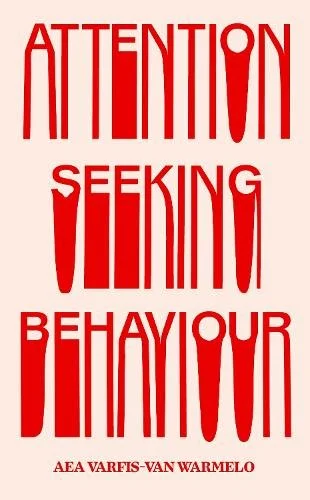
I sometimes really enjoy reading weird books, for want of a better phrase: novels that use an unconventional structure, mix genres, and find a kind of truth that so-called conventional storytelling can't reach. I often find them exhilarating and fun, if also frustrating, and I won't pretend to understand everything about them. But they revitalise my excitement about literature, which is supposed to do something novel, something that hasn't been done before. I had that feeling with "Attention-Seeking Behaviour" by Aea Varfis-van Warmelo.
A Novel, a Memoir, and an Essay
The book blends novel, memoir and essayistic non-fiction, including accounts of the history of lie detection. For most of the book we follow an unnamed narrator, whose name we only learn near the end. She's a young woman who writes poetry, has run writing workshops, and drifts through various jobs to make a living. She dates quite a few men and enjoys frequent sexual encounters. Over time she has also formed a relationship with a man she calls Normal Ben, a steady influence in her life with whom she shares a dark sense of humour.
But she has confessed things to him that may or may not be true. Early in the book she tells him she came across a body in the city and reported it. That sets up a psychological investigation into how truthful she is in this relationship, and how meaningful the relationship can be if some of what she tells him about her own life isn't true. She seems to have wrestled with this her whole life: she's a compulsive liar and also a compulsive thief. She steals chewing gum from Sainsbury's every day, then pays for expensive ham she likes to snack on. She is also working for a woman she detests and looks down on, and she finds ways to weasel out of any substantial work.
The History of Lie Detection
The narrator goes off on tangents about the people who pioneered so-called scientific methods for reading expressions and judging whether someone is telling the truth. That supposed science has been put into practice by law enforcement and at border controls, where it so easily leads to racial profiling and to misreading people whose personalities simply express themselves differently. She also covers the history of lie detector machines, which are still used in police work even though they've been discredited and tell us very little. All the while she is interrogating herself about how honest she can be about her own experiences.
One of the notes I made while reading concerns an ugly parallel in the book: police interrogators asking women who report being raped whether they are seeking attention. It connects the novel's title to how institutions decide whom to believe, and it ties into a line I marked early on, that facts are often irrelevant when confronted with the force of belief.
Truth, Fiction, and Identity
The book looks at the border between truth and fiction in our personalities. At some point in our lives, we've all told a lie, some big and extreme, others small white lies. We fashion an identity through the information we withhold, relate or manipulate, and I found this fascinating to ponder. The narrator becomes an increasingly compelling character, though obviously not an entirely sympathetic one. I was often critical of her for lying to a man who is, by all accounts, a good partner for her. A long and loving relationship requires some honesty, even when it's uncomfortable, even if we've grown accustomed to strategising how we present ourselves to be accepted or to steer a situation.
I also marked a few moments that stuck with me. Ben wants to defend her but can't fully know her, because she isn't honest with him. He can tell when she's exaggerating or lying, but he overlooks it. At one point he says he sometimes feels she doesn't trust him to understand her, so she exaggerates stories about her life, but he forgives it, thinking she just needs him to listen. In another passage she lists details about her life and ends the paragraph by thinking that not all of these facts were true.
There are also frank descriptions of sex, and these seem to be the only fully honest moments in her life.
The Surreal Edge
I loved the surreal aspect of the story: she increasingly just notes in passing that bodies lie around her as she walks through the city, such as a body hanging from a tree. Is this real to her, or a knowing fabrication from her imagination, or something she has convinced herself of? When we start to tell lies, there can be a dangerous point where we start to believe them, and they become part of our personality. That's testing and scary to confront: how much of the narrative we've built for ourselves is based on the truth, and how much on how we want to present ourselves?
Verdict
The author Luke Kennard is a fan of this book too, and he praises it as a scathing self-critique that left him with an understanding of himself he'd almost rather not have. That feels apt. His novel "Black Bag" also investigates personality and identity from an unusual angle, asking how much of us is authentic and how much is presented to the world, so I liked that connection. For me, "Attention-Seeking Behaviour" is a compelling, unconventional book that gets at truth by refusing to behave like a conventional novel.