First Impressions
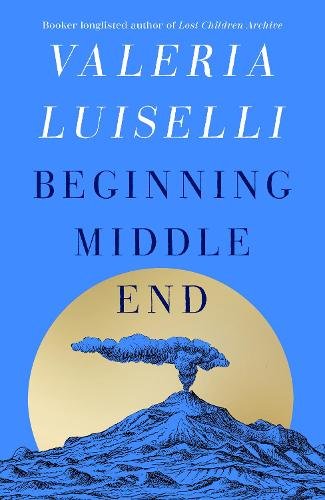
“Beginning Middle End” follows a mother and daughter in Sicily. The mother has recently published a book and gone on a European book tour, and she's also recently divorced. She and her daughter are staying in an apartment belonging to the mother's new lover, a musician currently away on tour, while the mother works on a new book whose shape she hasn't yet figured out, and the two of them read from classical literature together. They also carry with them a mosaic depicting theGreek god Proteus who is associated with knowledge of the future and the past. The mother's own grandmother found this artefact on an archaeological dig and kept for herself.
Where We Stand in Time
This novel is really about trying to locate ourselves in relation to time: where we've been, where we're going, and what it means to be in the middle of your life, uncertain whether you're heading toward a new beginning or already locked onto a path toward the end. It’s poignant how she feels a “nostalgia for the present” which can “warp time strangely”. All of that gets folded into the mother's own writing process and her thinking about narrative structure. There's a section where she considers Aristotle's rules of plot, the basic beginning-middle-end shape, and reconsiders what "the middle" actually means and “perhaps a defence of the middle is needed, a revindication of being in the middle, because eventually we have no choice but to be in the middle, caught in the middle, no longer able to swim back to shore, but realising the other shore is also still very far away: and where do we go from here?” I know a novel about the process of writing a novel can feel like a cliché, but I found Luiselli's handling of it genuinely poignant.
The book also looks across generations of women: the grandmother, the mother, and the daughter, plus the mother's own mother back in North America, who may be in the early stages of dementia. It asks what actually gets passed down between generations, and whether it's the accuracy of what's remembered that matters, or the feeling carried by the person doing the remembering. I liked how the mother and daughter stay unnamed throughout, which gives the whole thing a sense of continuity, as though the grandmother was once the mother, the mother was once the daughter, and the daughter might become a mother in turn. This is much more a contemplative novel than a plot-driven one, though there's a genuinely gripping moment at its centre when the mother has to make a dramatic decision shaped by their circumstances, all while the volcano Etna simmers in the background, its activity triggering wildfires that add real pressure to the story.
A Continuation, Not a Sequel
I hadn't realised this going in, but the book is clearly a continuation of Luiselli's earlier novel “Lost Children Archive”, a road trip story following a couple and their respective children as their relationship comes apart. Here we see the aftermath: the mother has left that man, taking her biological daughter with her, while his biological son stayed behind with him. Luiselli has said in a short interview that she doesn't consider this a sequel and within the novel itself she resists the idea that mother’s writing is autobiographical or auto fiction. It’s true that “Beginning Middle End” isn't a continuation in terms of plot so much as a return to the same people in an entirely new moment, grappling with different concerns. It does gesture back to the earlier book though, where the daughter in “Lost Children Archive” had a harrowing near-drowning moment, and the daughter here references that scene as though it happened to her, even though it didn't, since reading about it created a kind of false memory. That's very much what Luiselli is interested in here: what becomes "true" once a story or myth takes hold in our minds, and what the consequences of that are.
A Shift Late in the Book
There's a significant shift in form toward the end of this story that I know some readers have disliked. The novel becomes something closer to a collaborative project between mother and daughter, echoing how “Lost Children Archive” incorporated photographs alongside text. Part of me thinks the book might have worked just as well if the mother had simply kept writing the story herself, but I understand the larger point Luiselli is making with that formal turn. I'd be curious whether it landed for other readers or not. There's a line I found genuinely powerful, “I’m afraid of not knowing where to begin and how to end. Beginnings and endings are confusing: they are written as if in a foreign alphabet.” This gives a sense that we are in some senses lost in a perpetual sense of the middle of life, equally disorientated by a lack of true understanding about the past or a potential future. Luiselli’s story meaningfully contemplates how to inhabit the present of one’s life. I thought this was a beautifully intelligent and reflective book.