First Impressions
"Buckeye" is an utterly absorbing family epic, and although it spans multiple generations, it's really centred on two couples living in a small Ohio town, followed from the beginning of the Second World War through to the end of the Vietnam War. I spent that whole long stretch of time getting to know, care about and love all four of these people.
Four Equally Loved Characters
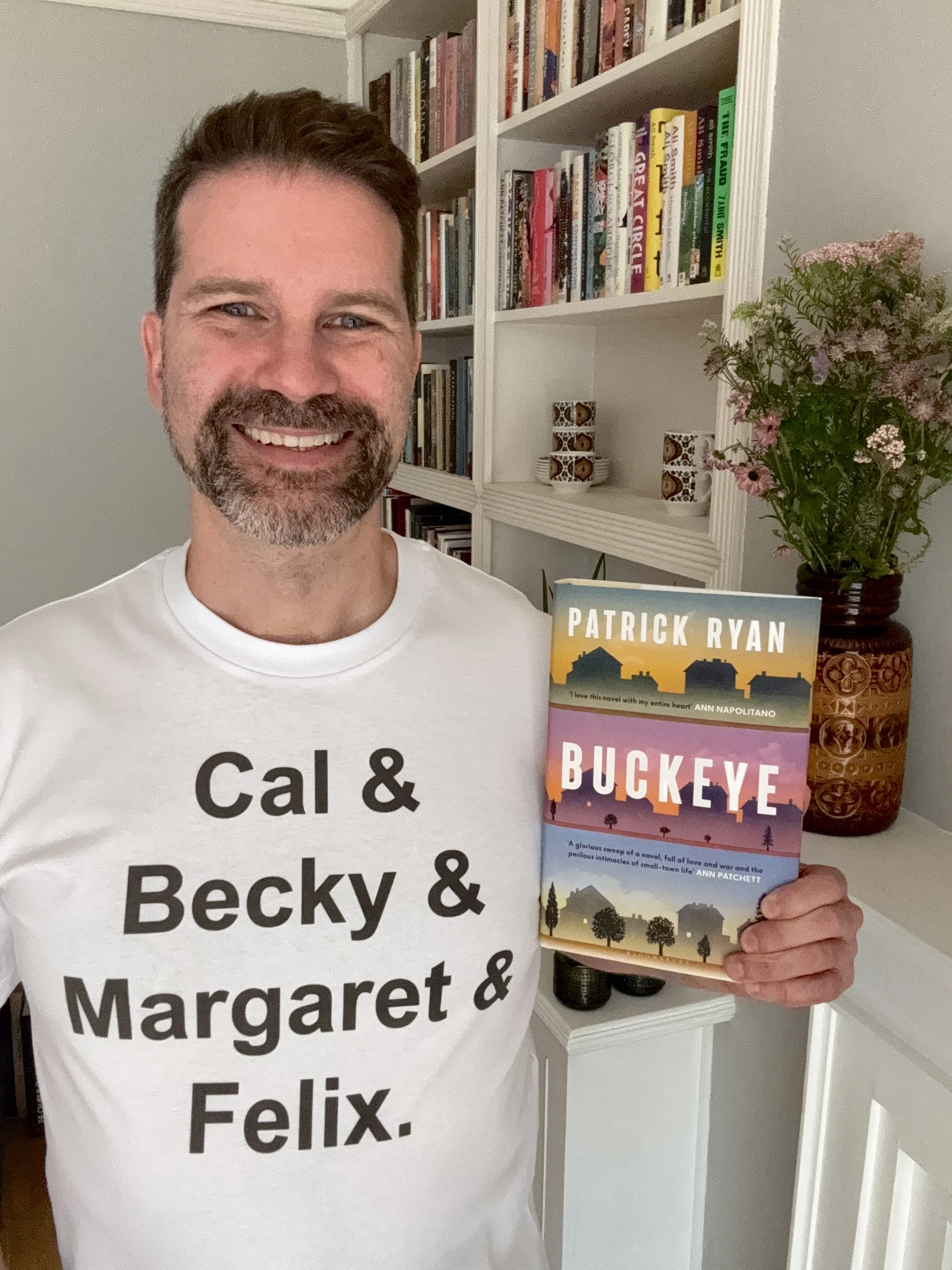
What struck me most is how the narrative moves between all four central characters, both their interior lives and their tangled relationships with each other, and I was equally invested in every single one of them. Usually in a novel that rotates between multiple points of view, I end up with a favourite and find myself impatient to get back to them. Here I loved all four so much that I actually made a t-shirt with their names on it, in the spirit of the famous "A Little Life" shirt with Jude, JP, Willem and Malcolm's names printed on it, even though that novel is really only about Jude and Willem. "Buckeye," by contrast, genuinely belongs to all four of its central characters: Cal, Becky, Margaret and Felix.
Cal and Becky
Cal, who we meet at the very start of the book, was born with one leg significantly shorter than the other, which causes him physical difficulty throughout his life and a lot of self-consciousness, including keeping him out of the military during the war. He also comes from a family where almost everyone has died except his father, leaving the two of them alone together in a dynamic that's claustrophobic and toxic, even though Cal still loves and cares for him. His father is a strange, memorable peripheral figure in the novel, a hoarder who writes complaining letters to American presidents and officials, letters that are reproduced in the text and capture both his personal quirks and a more universal sense of ordinary citizens' powerlessness to be heard. Cal himself is a hugely sympathetic character, a comic-book reader who falls for Becky, whose father owns the local hardware store where Cal goes to work, tying the two families together.
Becky is smart and sympathetic in her own right, and she's also given what's genuinely one of the more challenging elements of the novel for me: she can communicate with the dead, and the book takes this ability completely seriously. As someone who doesn't believe in anything outside the tangible and provable, I found it a real stretch at times to read a character who wholeheartedly believes in her own psychic gift, and that gap between her conviction and Cal's skepticism becomes a genuine source of tension in their marriage. Becky isn't a fraud or looking to profit from it either; she sees it almost as an obligation to the many grieving people around her. Early in the novel she also writes a letter to her future sixty-year-old self and gives it to Cal to keep sealed until then, a small mystery planted at the start whose contents, once revealed late in the book, feed back into everything the novel has been asking about her ability.
Margaret and Felix
The second couple, Margaret and Felix, are almost a golden couple on the surface, both strikingly good-looking, but each is carrying private secrets they never share with each other, and the novel traces the toll that takes over decades. Margaret was raised an orphan and longs for a wider world even as she finds herself settled in this small town; Felix is handsome, lands a promising job, goes off to fight in the war, and carries deep internal struggles that create real friction between them. The novel is remarkably attuned to the cost of everything we withhold from the people closest to us, and there's a striking line about how a lie carries its own unbearable solitude and that “you're alone when you tell it, alone when you live it, alone when you try to dismantle it.” That sense of isolation runs through both couples as they try to live authentically within the constraints and expectations of their era.
An American Ideal Under Pressure
Patrick Ryan captures something I felt very sympathetic to: that postwar American ideal of the nuclear family, the sense that conformity to a certain mould was supposed to guarantee happiness, and how, as we've since learned across the decades, that was never really true for a lot of people. At one point the novel invokes Norman Rockwell's idealised paintings of American domestic life directly, and shows how thoroughly these two couples fail to live up to that image. It also captures the way wartime creates an emergency that swallows up everything, deferring personal struggles that then take years, sometimes generations, to actually surface and be dealt with, including a thread about repressed sexuality and the quiet, cumulative damage of pushing something essential about yourself down for decades. Even though the novel is set in the past, it felt genuinely timely to me, saying something about our own more divided and anxious present.
The writing is full of vivid period detail, whether it's oddly coloured wartime rations or a genuinely terrifying combat scene that put me right inside the panic and consequences of it. The title itself grows in meaning over the course of the book: a buckeye tree is planted in one of the couples' yards early on, and its slow growth, beautifully echoed on the cover, mirrors how the choices, secrets and ruptures of this generation ripple forward into their children's lives. Ryan is so good at showing that most of these people are simply doing what they think is right in the moment, even as it quietly stores up trouble for the people who come after them, the way every family sets something aside meaning to deal with it later, only for it to compound instead.
Space, Astronauts, and a Personal Connection
There's also a recurring fascination in the book with outer space and the NASA program, which resonated with me personally since one of my own strongest early memories is the Challenger explosion, a kind of rupture in that whole postwar dream of progress. It isn't addressed directly in "Buckeye," but it's a preoccupation Ryan has returned to before, notably in his short story collection "The Dream Life of Astronauts," which includes a story about the Challenger disaster and features some of the same loosely connected characters as his earlier interlinked story collection "Send Me," which came out twenty years ago now. I read "Send Me" as a debut and fell completely for his writing back then, and I actually had the honour of meeting Patrick at Edmund White's apartment not long after, where he signed my copy. We became friends and corresponded a lot over the years, though we haven't been in close touch recently. I want to be clear that none of that affects my reaction to this book; if I hadn't loved it, I'd simply have read it quietly and moved on rather than talked about it here.
Verdict
I'm thrilled to see Ryan get this kind of attention after clearly working on this novel for a long time, and it's entirely earned. As Ann Patchett says on the cover, it's a glorious sweep of a novel, and it completely swept me up too; at around 450 pages, I honestly wished it were longer, since I would have happily stayed with these characters and their children's generation for much longer still. If you've read it, I'd love to know whether you felt the same pull toward all four of these people, or whether one of their stories won out for you over the others.
I had the pleasure of interviewing Patrick Ryan about his novel and you can watch our discussion here: https://www.youtube.com/watch?v=ISEekR287EU