First Impressions
“Land” is Maggie O'Farrell's tenth novel, and this is clearly a skilled writer at the height of her powers. She's already a beloved, award-winning author, but she's having quite the year: alongside this major new book, she received an Oscar nomination for co-writing the adapted screenplay for the “Hamnet” film with Chloé Zhao.
I read “Land” with my online book club, and we've had some really great discussions about it. It was such an immersive, atmospheric experience — first off, this is a family saga, and I have a passion for good family sagas. I wouldn't say I unreservedly loved this novel; I did have some issues with it, which I'll get to. But it's genuinely impressive how O'Farrell balances so many things in this story and packs so much into it, and the quality of the writing at a sentence level is such a pleasure to read.
Premise
The novel opens in 1865 on the west coast of Ireland, a decade after the Great Famine. We follow Tomás, an Irish mapmaker working for the British Ordnance Survey, and his reluctant ten-year-old son Liam, as Tomás sets out to map a certain section of the country. Their dynamic felt especially moving to me: quite quickly, Tomás undergoes a transformation that destabilizes their relationship, and Liam — who'd previously hated the work and didn't even want to be on this trip — suddenly just wants things to go back to normal, because he realizes he can no longer rely on the parent he'd always depended on. There's something so heartbreaking about a child recognizing that.
That split motivates the very different directions Tomás and Liam's lives take afterward, and it casts a shadow over the whole story. At first, Tomás's sudden change of course felt like it came a little too easily, but as the novel digs into his backstory, it becomes clear his turn is rooted in trauma from his own difficult past rather than being arbitrary.
It's a dramatic, surprising opening, and there's real suspense throughout — surprises I didn't see coming, both narratively and in terms of plot. O'Farrell sustains real tension across a relatively long book, though I think it could have been even longer, honestly, since there were other elements I'd have gladly read more of.
This novel is about so many things at once: a family story, emigration from Ireland, the relationships between family members and how they transform over time, connections and breaks within families, the history of Ireland and British colonialism, mythology, and the psychology of its characters. It intertwines all of these elements into a genuinely riveting tale.
Details in the Cover
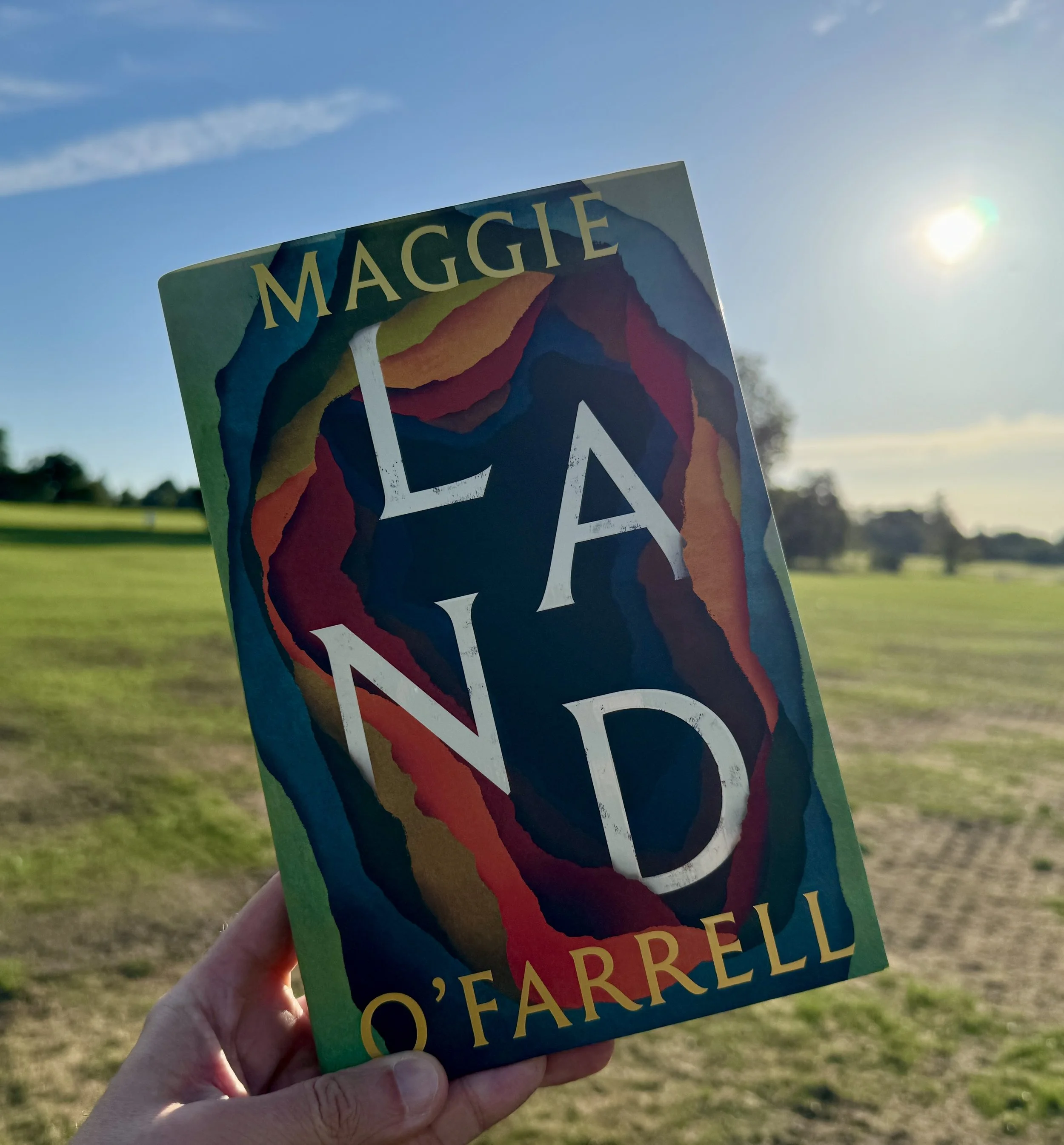
One of the joys of this book — at least the UK edition — is that there are design elements embedded in the cover that click into place once you've read it. I have to credit members of my book club for pointing some of these out. Renee spotted a small embossed gold fish on the back cover, which turns out to carry real weight once you know the mythology underneath this novel (more on that below). Nancy noticed that if you turn the cover on its side, the black shape in the middle looks like a dog sitting at rest — and there is indeed a dog in this novel, part of a lineage of dogs that matters a great deal to the story. I love how O'Farrell included a non-human animal this way; the land in this novel doesn't just belong to the humans, but to other inhabitants too, living, dead, and mythological.
The Weight of History
It's impressive how O'Farrell balances the real history of people who suffered through the Great Famine with the rest of the story. We see a village that's been decimated, and there's a very moving early scene where Tomás meets a local widow while trying to remap the area — she recounts, house by house, which homes are empty and which have only one or a few survivors left. There's a heartbreaking moment where she sorts through clothes she made for her now-deceased family, conveying the scale of the collective grief in that community.
The occasional references to the Viscount are genuinely chilling — a figure of imperial greed who holds sway over the locals' lives while living in his own separate, privileged reality, physically close to Tomás and the villagers but worlds apart socially and financially. It's a legal requirement of tenancy, we're told, for locals to salute the Viscount whenever they encounter him — which is absolutely outrageous, and it made me think about how the demarcation of borders on a map isn't just an abstract exercise in geography. It has legal ramifications that shape the tangible, daily reality of whoever lives on that land.
Early on, the book also carries real Dickensian notes, especially in the sections touching on Tomás and his wife Phina's early life together and the hardships they endured.
Part of the emotional anchor of this book, as O'Farrell has discussed in interviews, is her own strong connection to it. She was born in Ireland (though raised mostly in Scotland and Wales), and her great-great-grandfather — also named Tomás — was commissioned by the British Ordnance Survey to map the land, just like the character. He also had a son who became a Jesuit, which is the basis for Liam's storyline.
She's exploring her own family history and imagining what life must have been like for these ancestors — something I think most of us wonder about, usually with only scattered fragments of information to go on. That's really at the heart of this book: wondering about people from the past, the struggles they faced, and putting ourselves in their shoes. It ties into Ireland's long history of diaspora, where economic and political hardship forced people to leave and try to build better lives elsewhere, fragmenting families across the world.
A major theme of the book is disconnection, and O'Farrell renders it in some genuinely moving ways — there are several instances throughout the novel of family members who lose touch, or who come close to each other without ever realizing it, because of everything that's been severed by displacement and time. It's a far-fetched kind of coincidence in places, but this sort of thing has probably happened many times throughout history — so much gets lost between generations as people move and family connections are severed. O'Farrell uses this to show how large historical forces and institutions can transform a family from a single unit into disconnected individuals struggling to survive on their own. There are also moments where connections are painfully, movingly reformed, and even with the coincidences involved, it felt believable to me given how common this kind of dispersal actually was.
A Note on Tone
Some people in my book club found this book, while an excellent reading experience, quite depressing overall, and I'd agree that a few specific moments feel almost overwhelmingly sad, on top of the reverberating effects of the Famine that shadow the entire story. I think it's partly a somber book because it's representing the lives of people caught up in real historical tragedy, both on a large scale and an individual one.
But O'Farrell tempers this with instances where hope is possible. There are several moments where things could easily have gone much worse for these characters than they actually do, and O'Farrell includes a real amount of hope alongside the awfulness. It builds genuine dramatic tension — I couldn't predict how things would turn out for these family members, and I mean that as a compliment.
Structure
Technically, this novel is quite unusual — O'Farrell puts it together in a structurally ambitious way, but it never left me confused, even when I was surprised by where it went. It's broken into parts rather than chapters. The first part switches between three timelines: Tomás and Liam in 1865, Tomás's own childhood, and a future point involving Liam. It keeps moving between these until you really understand these characters, and it builds a larger, more complex picture of Tomás.
At another point, the narrative plunges into the deep history of the land itself, centered on a sacred spring in a copse that Tomás and Liam stumble across — I found this section genuinely inventive and fun, and it clearly shows the influence of “North Woods” by Daniel Mason, which O'Farrell has cited in interviews: if you've read it, you'll know it centers a single house as its own protagonist across centuries of inhabitants. O'Farrell has taken this kind of experimental approach to narrative and time before, too — most notably in “Hamnet”, which tracks the bubonic plague's journey as it reaches England.
Later, O'Farrell springs a genuinely clever structural surprise involving the siblings that I didn't see coming and won't spoil here. Techniques like this add a great deal of suspense to the reading experience, and it's part of why I think this book works so well specifically as a novel, and not just as a cast of characters waiting to be brought to life on screen, which was a criticism Melissa Harrison raised in her Guardian review of the book.
Irish Mythology Woven Through
O'Farrell folds a handful of Irish myths into this family saga so that the prehistoric past and 1865 feel like the same ground remembering itself. It's a poignant detail that the author's father used to read her these myths when she was a child — something she resented at the time but is grateful for now. I've been enjoying reading more about these and how they might have inspired O'Farrell in writing this novel.
The spring that Tomás and Liam discover draws on the legend of the Salmon of Knowledge: a salmon that eats the hazelnuts of wisdom that fall into a sacred well, so that whoever eats the salmon in turn gains all the world's knowledge — this is how the boy Deimne becomes the hero Fionn mac Cumhaill. It's a lovely detail that the golden fish embossed on the back cover turns out to be a quiet key to the whole novel once you know this myth. The spring the family finds isn't just a pretty piece of landscape — it's the well of wisdom from the oldest layer of Irish myth, and the cover is quietly signalling that from the start.
Sacred wells with healing powers are an important strand of real Irish folk practice, and this was clearly a major influence on O'Farrell, who has described visiting a number of these wells scattered around Ireland. There's also the legend of Oisín, a man who leaves for the Otherworld and returns to find centuries have passed, aging instantly the moment he touches Irish soil again — I think this legend was on O'Farrell's mind while writing the novel's emigration strands, even if (as I get into below) those sections abroad aren't quite as engaging as the ones set in Ireland.
The family dog is named Bran, after Fionn mac Cumhaill's own legendary hound — and in the myth, Bran isn't an ordinary dog at all, but a transformed human, born to a woman who was turned into a hound while pregnant. O'Farrell draws on that myth in a way that blurs the line between human and animal, in exactly the way the cover's hidden dog silhouette hints at.
Irish folklore is also full of people turning into animals, and of changelings — uncanny children who carry a wisdom beyond their years. That idea is embodied in Eugene, the novel's nonverbal son, who can be read simultaneously as a child with a real, grounded condition and as something more mythic. There's a genuinely satisfying payoff to this thread by the novel's end, which I'll leave for you to discover.
Where It Loses Some Steam
O'Farrell has said she deliberately set out to write a different kind of Irish emigration story, since there are already so many excellent ones. The novel follows Liam and Enda as they move abroad, and how their individual stories unfold is genuinely surprising. Enda, who has natural musical talents, has a story I found fascinating, if harrowing. Liam's strand — training with the Jesuits — I found less engaging; it felt more plodding, and I kept wanting the book to return to the main family story back in Ireland. I suspect O'Farrell became especially invested in Liam's section because of how directly it mirrors her own family history: her great-grandfather joining the Jesuits (a significant thing for a rural boy at the time) and later leaving the order (also significant). It's understandable she wanted to imaginatively fill in so many details about this occurrence, but I felt it did pull focus from the stronger core of the book.
Characters and Where It All Lands
I was deeply engaged by Tomás and Phina's relationship, which changes over time as circumstances pull the two of them in different directions. The split between Tomás and Liam is painful, but it's moving to watch how their relationship evolves over the rest of the book. I also appreciated the tense, prickly relationship between Tomás and Enda, which shifts in some rewarding ways as the story goes on. Rose, understandably, has real friction with Enda over the course of the novel, and following where that relationship goes was one of the more affecting threads for me.
There's also a lovely recurring object: a shawl connected to Phina's side of the family, which survives only as a single tassel by the story's end — the kind of small, seemingly inconsequential object so many families keep passing down long after its original meaning has been lost.
Where the novel ultimately lands is dramatic and genuinely hopeful — O'Farrell gives the story real emotional light amid the tragedy and puts a clever new spin on the mythology she's built up throughout its final pages. Even with some reservations, and a few coincidences that stretch credulity, I was completely swept into this novel and really enjoyed the experience. What Maggie O'Farrell has done here is genuinely impressive.
If you've read this book, I'd love to know what you thought: what were your favourite elements, what did you make of the structure, did the mythology woven through it work for you? And if you're thinking about reading it, or have another favourite Maggie O'Farrell novel, I'd love to hear about that too. Of her other books, a couple I've found completely immersive are “The Marriage Portrait” and “This Must Be the Place” — though “Land” might now be my favourite of hers. It's a great achievement, and I had such a wonderful time reading it.