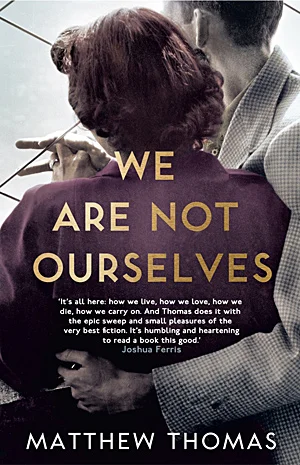
Do you ever finish a novel and feel so close to the characters that it’s like you’re suddenly in mourning because your experience with them has ended? That’s the feeling I had after I read the final page of Matthew Thomas’ “We Are Not Ourselves.” Part of the reason I felt so attached to the central characters in this book is because this is quite a lengthy family saga and so it was as if I travelled through every crucial stage of their lives. It follows three generations of a family starting with a hard-drinking Catholic Irish couple in New York City in the 50s and ending in 2011. This novel traces one family’s journey but primarily focuses on a woman named Eileen. She’s a woman I felt very close to because her background closely mirrors that of my own mother who is also of Irish heritage and grew up in that city during the 50s and 60s. Born into a difficult working-class background, Eileen is a tough-spirited intelligent woman who seeks to live out the American dream by establishing a secure middle class lifestyle for herself and her family. However, her idealism crumbles amidst the harsh realities of life and the compromises one must make to keep a family together.
The author is in many ways a very traditional novelist relating his story in descriptive eloquent prose which draws you into the reality of his characters. This isn’t at all a bad thing. By evoking the sensations of their experiences and succinctly capturing their thoughts he admirably grounds the reader in not only what it felt like to physically live in these changing eras of American life, but also experience the influence of the cultural attitudes and ideologies of those times. The tight-knit but relatively poor Irish community Eileen is born into gradually morphs over the decades into a much more diffused suburban lifestyle where families live in comparative isolation. Much later in the novel when Eileen likes to spend time in chain coffee shops she observes that “People were islands even when they sat together.” This transformation is particular to Eileen’s journey but also generally follows economic and social changes of the times. Matthew Thomas shows that the desire for suburban tranquillity is entirely understandable because of the very difficult reality which Eileen comes out of where “Everyone needed something to believe in.” Unfortunately, the thing she believes will give her the stability she desires turns out to be something of an illusion.
The testing circumstances Eileen lives under in her youth seem to her entirely natural and a hard reality that must be endured until she discovers that “There were places, she now saw, that contained more happiness than ordinary places did. Unless you knew that such places existed, you might be content to stay where you were.” She’s dazzled by the promising beauty of Christmas displays in shop windows, the prestige which accompanies wearing a mink coat and indulgently takes tours of properties for sale which are much more expensive than anything she could afford. Particular areas of the city change greatly over the time period covered in the novel and witness the influx of many minority groups. While Eileen always admired her father for taking a stand on issues of racism, she can’t help worrying about how the changing neighbourhood affects property prices. In one striking scene she has a vociferous outburst towards a young group of minorities who defend themselves saying that they were also born here. Later she fabricates a memory of this encounter in her mind to align with a stereotypically prejudiced idea of how she feels threatened by other racial groups. It’s a sobering portrait of how discrimination isn’t usually exhibited through outright racism, but influences opinions and even transforms memory due to paranoia and fear.
It comes as no surprise that when Eileen finally moves to a neighbourhood she deems respectable and inhabits the house of her dreams, the illusion of perfection quickly crumbles. As the author remarks: “So much of life was the peeling away of illusions.” This is closely tied to the way in which capitalism so often works where idealistic visions are marketed to seem so appealing, but once ownership takes place the desired object suddenly seems shabby and disappointing. The cherished mink Eileen pines after feels stuffy, over-hot and not worth wearing once she’s actually acquired it. More seriously, she comes to realize that the society she is a part of won’t actually sustain her and her family in times of medical need. In a passage which is uncharacteristic in this novel because of what a bluntly damning indictment it is Matthew Thomas writes:
“She’d worked her whole life and diligently socked away, from the age of fifteen on, 10 percent of every paycheck she’d ever gotten, and still her family’s fortunes could be ruined overnight because the American health care system – which she’d devoted her entire professional career to navigating humanely on behalf of patients in her care, and which was organized in such a way as to put maximum pressure on people who had the least energy to handle anything difficult – had rolled its stubborn boulder into her path.”
The author is keenly aware of the financial strains of ordinary hard working people who encounter tragic circumstances. Because there isn’t a structure in place to support them when they need it most, their suffering is compounded by the extra hardships they must take on simply to survive. Loving couples must contemplate financially strategic ways of outwitting the system, but which are demoralizing to their way of life. Both the worker and the workplace suffer because a sick employee can’t afford to take the time off or leave his/her job at times when they are incapable of adequately fulfilling their responsibilities. Intelligent individuals fall prey to the scams of con-artists in order to find the emotional solace which can’t be found elsewhere. The author cleverly embeds these larger social issues into his mesmerising narrative about this family’s struggle.