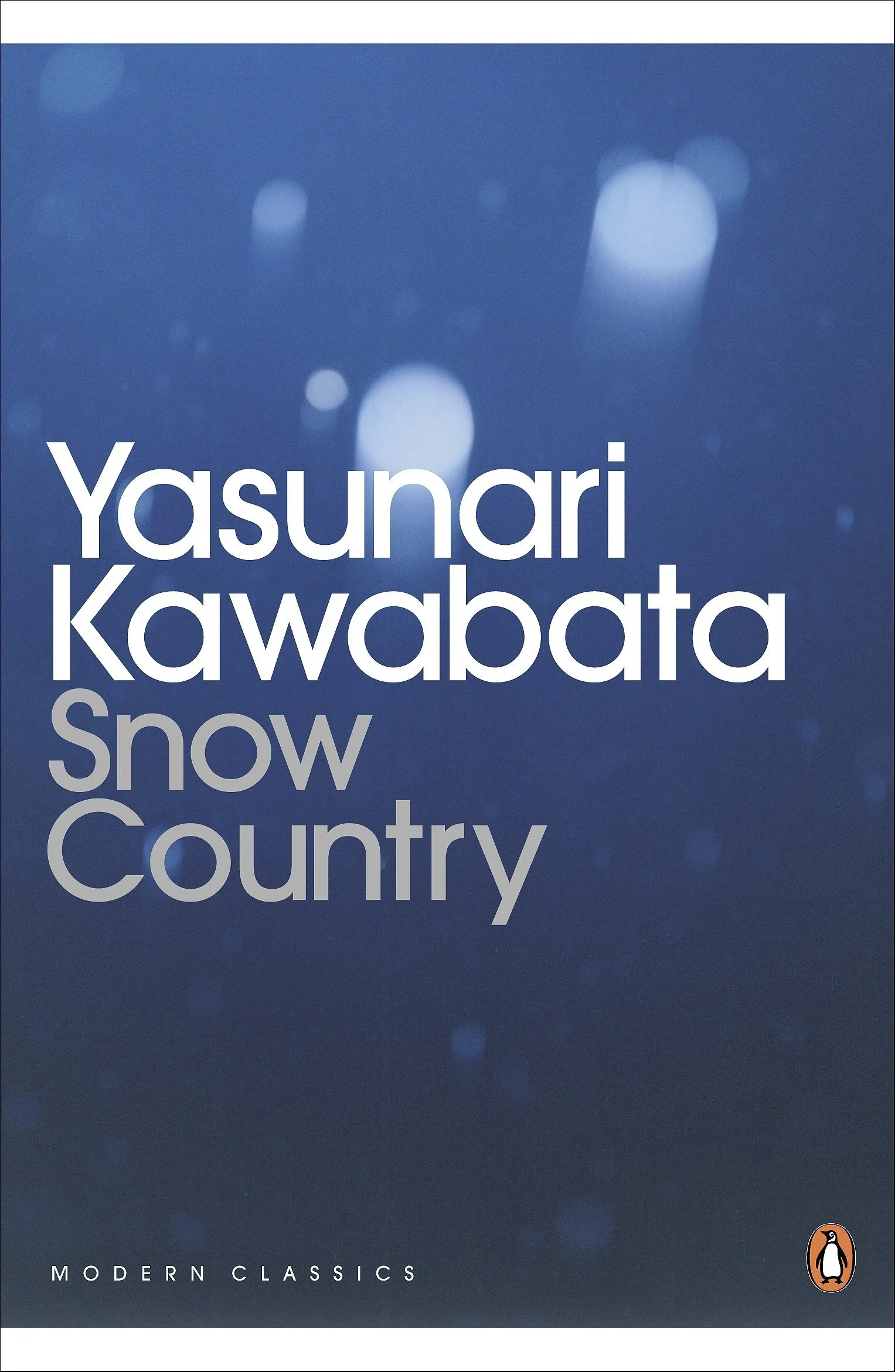
This is the first book I've read by Kawabata who won the Nobel Prize for Literature in 1968 and died four years later (probably from suicide although that isn't certain.) Despite its being only 121 pages long it took me longer than usual to read “Snow Country” as the style demanded a lot of concentration. It took some time to become accustomed to its extreme attention to detail, ambiguous meaning and odd manner of storytelling. I think there are a couple of reasons why reading this novel felt challenging. Firstly, Kawabata melded his narrative with characteristics of haiku poetry which includes minimalism, a juxtaposition of imagery and a focus on fleeting moments. I found it so odd in the beginning of the novel that Shimamura focuses on the reflection in the train's window so intensely and for an extended length of time. However, this sense of perspective where the landscape is overlaid with a woman's image introduces the way in which the protagonist desires to only experience beauty and life at a remove, elevating aesthetic admiration over true engagement.
Secondly, it also felt like there are some cultural references points in this novel which made it challenging to understand – especially to do with the function and role of geisha. There's a lot of misconceptions about geisha in the West which (especially after WWII) often equates their practice with that of courtesans or prostitutes. Traditionally geisha don't perform sexual services for their clients but rather deliver highly developed forms of entertainment and artistic practices. Certainly Shimamura is attracted to Komako, but do they have sex? I don't think it's ever explicitly stated and many responses to this novel have assumed that Shimamura is an older man who simply employs Komako for sex. I'm not defending Shimamura who comes across to me as a very entitled and negligent individual. And, of course, as is described in the novel, sometimes clients do become romantically involved with geisha and help them to move onto different professions. This seems especially true in this rural region where opportunities and treatment of geisha seem different than that in the city. So perhaps in this area they are treated more as escorts. As with so many things about this novel it's ambiguous what emotional and sexual relationships form between the geisha and clients.
The tension between Shimamura and Komako is at the heart of the story. I felt there was a real affection between them, but it couldn't ever develop into a true romance. Shimamura is married and has a family but also only wants to admire beauty at a distance. There are many things about his character which seem contradictory and ridiculous – such as considering himself a ballet expert though he's never actually witnessed one. This seems to emphasise his tragic remove from life where he goes off to this spa whenever he feels like it. Here he doesn't have to deal with the reality of his family and he's under no obligation or commitment to Komako. From what I remember the only mention we get of his wife is her concern about his clothes potentially being ruined by moths so we have no idea about her real state of mind but I wonder if she's glad to be left in peace while Shimamura is away. Though he seems to realise this lifestyle can only be temporary he keeps extending his stays at the spa and wants to persist in this odd limbo. Alternatively, Komako doesn't have the freedom of wealthy Shimamura. Something I found endearing about her are her notebooks where she records everything she's read in her life – I found Shimamura's snobbishness about the notes she keeps to be so off-putting. Komako has debts and obligations she's working to overcome. Meanwhile, her youth is quickly draining away. Her frustration about this seems to express itself in her erratic behaviour and frequently getting drunk. She treats Shimamura with a lot more familiarity than a client, but doesn't seem to be able to fully trust or rely on him either.
I did find it a struggle to get a grasp on their relationship. Shimamura idealises Komako as he frequently describes her cleanliness and that she's a “good girl” (eventually this changes to a “good woman” which offends Komako.) However, this seems to deny the complexity and simplify the messiness of the young woman's life. Komako herself runs hot and cold in her affection for Shimamura. Speaking of temperature, the imagery of snow and fire repeat in the book in a way which seems to express something about the inner lives of the characters. There are beautiful descriptions of the landscape being covered in snow. This seems to reflect Shimamura's cold detachment. As a contrast to that Komako is often described as feeling extremely hot and, at one point, it describes her being on fire. This all seems to be reflective of the shifting stasis or passion which the characters feel. Of course, the climax of the novel is a life-threatening conflagration witnessed by Shimamura and Komako. They witness something shocking regarding another character named Yoko. Rather than concern for Yoko or Komako, Shimamura is focused on the night sky and the beauty of the Milky Way. I'm inclined to believe he'll simply return to his family and Komako will continue to get more jaded and frustrated with her limited options in life.
Overall, I grew to appreciate the subtleness and moodiness of this strange little novel but it's not an experience I found easy or entirely enjoyable. This transcription of a lecture by translator Edward G Seidensticker is very interesting as it comments upon the special challenges of translating “Snow Country” in particular: https://swet.jp/articles/article/my_sort_of_translating/_C30 In particular, I found this line from his lecture funny: "when I was working on Yukiguni, which was the first long Kawabata I translated, I would ask him about things and he was no help at all. I would say “Isn’t this a rather ambiguous passage, Sensei?” He would look at it and nod and say, “Yes, it’s ambiguous,” but he wouldn’t give me any interpretation of it whatsoever. I stopped asking." It sounds like the translator had to make some difficult decisions and tried to preserve the ambiguity of Kawabata's text. But I think that makes it especially challenging for English-speaking readers to get into as its a very different sort of narrative style.
I'm glad to have read this lauded Japanese author's work and it's seasonally appropriate. Though this book captures the atmosphere of winter it's definitely not very festive. Nevertheless, it's a text where I admired the beauty of detail and the state of reflection which the author creates.