First Impressions

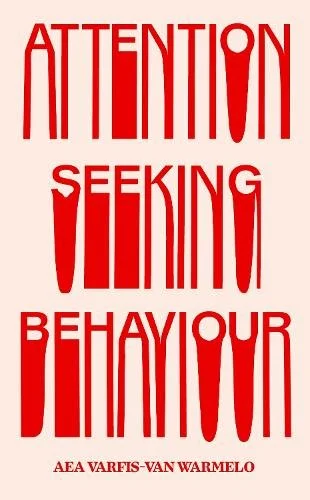
I sometimes really enjoy reading weird books, for want of a better phrase: novels that use an unconventional structure, mix genres, and find a kind of truth that so-called conventional storytelling can't reach. I often find them exhilarating and fun, if also frustrating, and I won't pretend to understand everything about them. But they revitalise my excitement about literature, which is supposed to do something novel, something that hasn't been done before. I had that feeling with "Attention-Seeking Behaviour" by Aea Varfis-van Warmelo.

A Novel, a Memoir, and an Essay

The book blends novel, memoir and essayistic non-fiction, including accounts of the history of lie detection. For most of the book we follow an unnamed narrator, whose name we only learn near the end. She's a young woman who writes poetry, has run writing workshops, and drifts through various jobs to make a living. She dates quite a few men and enjoys frequent sexual encounters. Over time she has also formed a relationship with a man she calls Normal Ben, a steady influence in her life with whom she shares a dark sense of humour.

But she has confessed things to him that may or may not be true. Early in the book she tells him she came across a body in the city and reported it. That sets up a psychological investigation into how truthful she is in this relationship, and how meaningful the relationship can be if some of what she tells him about her own life isn't true. She seems to have wrestled with this her whole life: she's a compulsive liar and also a compulsive thief. She steals chewing gum from Sainsbury's every day, then pays for expensive ham she likes to snack on. She is also working for a woman she detests and looks down on, and she finds ways to weasel out of any substantial work.

The History of Lie Detection

The narrator goes off on tangents about the people who pioneered so-called scientific methods for reading expressions and judging whether someone is telling the truth. That supposed science has been put into practice by law enforcement and at border controls, where it so easily leads to racial profiling and to misreading people whose personalities simply express themselves differently. She also covers the history of lie detector machines, which are still used in police work even though they've been discredited and tell us very little. All the while she is interrogating herself about how honest she can be about her own experiences.

One of the notes I made while reading concerns an ugly parallel in the book: police interrogators asking women who report being raped whether they are seeking attention. It connects the novel's title to how institutions decide whom to believe, and it ties into a line I marked early on, that facts are often irrelevant when confronted with the force of belief.

Truth, Fiction, and Identity

The book looks at the border between truth and fiction in our personalities. At some point in our lives, we've all told a lie, some big and extreme, others small white lies. We fashion an identity through the information we withhold, relate or manipulate, and I found this fascinating to ponder. The narrator becomes an increasingly compelling character, though obviously not an entirely sympathetic one. I was often critical of her for lying to a man who is, by all accounts, a good partner for her. A long and loving relationship requires some honesty, even when it's uncomfortable, even if we've grown accustomed to strategising how we present ourselves to be accepted or to steer a situation.

I also marked a few moments that stuck with me. Ben wants to defend her but can't fully know her, because she isn't honest with him. He can tell when she's exaggerating or lying, but he overlooks it. At one point he says he sometimes feels she doesn't trust him to understand her, so she exaggerates stories about her life, but he forgives it, thinking she just needs him to listen. In another passage she lists details about her life and ends the paragraph by thinking that not all of these facts were true.

There are also frank descriptions of sex, and these seem to be the only fully honest moments in her life.

The Surreal Edge

I loved the surreal aspect of the story: she increasingly just notes in passing that bodies lie around her as she walks through the city, such as a body hanging from a tree. Is this real to her, or a knowing fabrication from her imagination, or something she has convinced herself of? When we start to tell lies, there can be a dangerous point where we start to believe them, and they become part of our personality. That's testing and scary to confront: how much of the narrative we've built for ourselves is based on the truth, and how much on how we want to present ourselves?

Verdict

The author Luke Kennard is a fan of this book too, and he praises it as a scathing self-critique that left him with an understanding of himself he'd almost rather not have. That feels apt. His novel "Black Bag" also investigates personality and identity from an unusual angle, asking how much of us is authentic and how much is presented to the world, so I liked that connection. For me, "Attention-Seeking Behaviour" is a compelling, unconventional book that gets at truth by refusing to behave like a conventional novel.

Posted
AuthorEric Karl Anderson

It's always fascinating to read a re-discovered piece of queer writing. Though Mark Hyatt actively brought out poetry in the English bohemian scene of the 1960s, his novel “Love, Leda” has only been published posthumously this year. It's a fascinating snapshot of gay London life from that period in the time leading up to the Sexual Offences Act of 1967. The book's eponymous hero Leda has no fixed abode and bounces between male and female lovers while earning a bit of cash from low paid jobs in metal work and kitchens. He's estranged from his family and for good reason – when he feels obliged to visit with his parents and siblings there's a horrifically violent encounter with his disapproving father. The narrative veers from moments of raw emotional confession “Sometimes I find that I am humiliated by myself, and my thoughts get out of hand, becoming absolutely evil, and immediately I am nothing” to frivolous fantasies “during the long time of waiting for the train I appoint myself as Jesse James in full drag waiting for this very train and about to steal all the cash belonging to the G.P.O.” Moreover, it's fascinating following him as he navigates the back streets of Soho putting flowers in his hair and dabbing perfume behind his ears while dipping into the lives of outcast artists, dissidents and bored housewives. All the while he consumes countless cups of coffee and frequently lapses into poetic reverie.

There's something refreshing about reading a novel that's so organic and unpolished. That's not to say the book isn't sophisticated because it contains some absolutely beautiful lines, vivid descriptions and thoughtful commentary. But I can imagine the narrative would receive a complete overhaul in a contemporary creative writing class because it's quite chaotic. Some of the passages and lines of dialogue feel disorientating with their convoluted logic. Perhaps if Hyatt had the chance to work with an editor these would have more clarity. But, on the whole, I think it's better that the text has been preserved in its raw emotional form. The fascinating forward and afterward explain how Hyatt came from a working class background and received very little formal education. Learning how drawn the author was to suicide, it's hard not to read the story as autobiographical. There are frank passages describing his sense of alienation. He laments at one point that “I am far too feminine to be living in a man's world.” In another section he reflects how “My own experience tells me that more love goes into the thought of homosexuality than the practice.” Though he may have heated and powerful hookups, none lead to a loving connection.

This leaves him adrift and while he certainly possesses a melancholy streak, he also emits catty asides and biting humour along his journey. He even emanates a pissy arrogance when walking down the street and when someone bumps into him he indignantly muses “Why don't people look where I'm going? Walking into me like that.” There's a wonderful extended tragi-comic scene towards the end of the book when he's charged with looking after two little boys on a seaside trip. It's hilarious how indifferently he tends to them while they consume enormous amounts of sugar and cause havoc. But there's also a sadness to this as he's feeling so estranged from life: “I think I live without knowing myself and I laugh at the world to kill my pain. I cry because I can't understand it and I am constantly in dreams that somehow I hope time will not cure.” It's extremely touching reading such insights from a man so frankly discussing his queer experience from decades in the past and it's wonderful being immersed in this bygone urban landscape of Lyons' tea shops.

Posted
AuthorEric Karl Anderson
CategoriesMark Hyatt

Isabel Waidner has invented such a unique style of writing that's a mixture of social commentary, wildly creative imagery and buddy humour. I feel like Waidner is a modern-day Joe Orton. “Sterling Karat Gold” is a play on Kafka's “The Trial” in which an innocent character named Sterling is arrested after unwittingly being drawn into a bull fight in London's Camden Town. Sterling faces prosecution by a corrupt judge, enlists the help of friends, grapples with their lost father, stages a radical theatre production and uses space ships to cross time barriers. If this sounds too fanciful let me assure you that these stretches of the imagination always feel rooted in real-world issues and reflect the feeling of being marginalized within oppressive systems. As a character named Chachki states at one point: “correcting falsified narratives is important; but conjuring counter-realities even more so.” The bizarre quest which Sterling embarks on has the effect of liberating these characters and the reader from the restrictions and limitations we are forced to live under by plotting out new possibilities. It's also fantastic fun to read and gives a warm sense of camaraderie. 

The novel begins with Sterling stating that they lost their father to AIDS. It's gradually revealed that in his football career he had an affair with Justin Fashanu who was and still remains the only major English footballer to come out as gay. He later committed suicide. In the narrative, Fashanu becomes a kind of imaginary step father to Sterling. As in Waidner's earlier novel “We Are Made of Diamond Stuff” the referencing of real-life historical figures serves as a cultural reference point for individuals who broke through the static of the mainstream narrative to make their voices heard, but were ultimately strangled by society's restrictive perceptions about their identity. In addition to considering this history, Waidner's novel is also a powerful contemplation of the absurdity of the world today reflecting the feeling that “we were non-consensual participants in a reality put together by politicians, despots, more or less openly authoritarian leaders.” This leads to dangerous disillusionment and resignation because of the sense that “we're alive in a substandard fiction that doesn't add up.” Through this visionary new fiction Waidner shows how we don't need to settle and conform to the reality we've been offered but can boldly make our presence known and reform the mainstream narrative.

Posted
AuthorEric Karl Anderson
CategoriesIsabel Waidner