This One Sky Day Leone Ross.jpg

This novel introduces readers to the archipelago of Popisho, a fictional series of islands which form a nation of people possessed with magical qualities and real world concerns. The day begins with Xavier being tasked with preparing a wedding feast for an influential man's daughter. His special ability is being able to season food just with the palms of his hands. This is a super power I never knew I needed but think about how convenient it would be! No more rooting through cluttered spice racks. But Xavier also possesses the title of macaenus, a coveted and specially appointed position in which he prepares a once in a lifetime meal for every person exactly when they most need it. He's also haunted by his wife who died in the ocean and literally stalks the islands while her body gradually disintegrates. Wild enough for you? This is only the beginning of a fantastical journey infused with the awe-inspiring pleasure of dreams and the intensity of nightmares. At one point in the novel there's a magical burst which affects all the women on the island and their affliction is so shocking I couldn't believe what I was reading! I love that Ross has the courage to not only depict such a mischievous event but carry its logic through so we see how it results in chaotic transformation. This wondrous tale confidently leads the reader though the stories and lives of its vibrant characters to inspire, enchant and provoke thoughtful reflection. 

There's a lot happening in this novel with its large cast of characters, multiple plot lines and complex politics which the reader must try to keep straight while also becoming accustomed to the magical qualities which abound through these islands. But, even though I found myself racing to keep up at some points, there's a propulsive energy to this narrative which is so excitingly fresh and delightful that I was utterly mesmerized. The humour and charisma of its characters shines through in the vernacular of their dialogue. It's a book I'll eagerly enjoy returning to in order to better understand its intricacies and indulge again in the all-consuming sensory experience of it. If assigning novels to a genre is your thing “This One Sky Day” would comfortably sit under the heading of magical realism or speculative fiction. But, while such categories are useful to indicate the type of reading experience you will get, no one box will adequately describe the bewitching flavours and electric sensations this novel contains. The magical elements it possesses aren't indulgent flourishes but allow us to consider subjects such as love, addiction, corruption, grief, the legacy of colonialism, classism, sexism, homophobia and infidelity from an entirely new angle. As much as I appreciate a good realistic novel that stays true to the laws of gravity and the bone-dry ticking of the clock, I do love a story that fully embraces a boundless imagination to reshape the world into a thing of wondrous beauty. This novel made me see life in explosive colour again and I loved reading it.

Posted
AuthorEric Karl Anderson
CategoriesLeone Ross
Circus of Wonders Elizabeth Macneal.jpeg

The 2017 cult hit film 'The Greatest Showman' inspired marginalized people about the solace that can be found by establishing your own community with others who don't fit in with larger society. But it also perpetuated a dangerous mythology about P.T. Barnum as a showman who wholeheartedly believed in this ethos and deeply cared about the welfare of the performers in his freak shows and circuses. Elizabeth Macneal's new novel “Circus of Wonders” presents a more complicated fictional story of such an impresario with Jasper Jupiter who in 1866 aspires to create a show that will eclipse Barnum in its success and draw Queen Victoria to attend. He does this through mercenary exchanges purchasing individuals with physical aberration from their families, tyrannically working his crew and making dangerous deals to enhance the spectacles. Though this egotist's circus is at the centre of this novel, Macneal primarily focuses instead on the points of view of two far more sympathetic characters. 

A young woman named Nell feels isolated in her community because of birthmarks which speckle her skin and, though she's kidnapped by Jupiter, she comes to embrace the circus' opportunities and the sense of importance which comes from being refashioned into a wonder known as the “Queen of the Moon and Stars”. But she soon realises that this isn't necessarily an empowering form of celebrity, her newfound freedom has limitations and the public's adulation has a sinister side. Jasper's brother Toby has always been the more awkward and less favoured of the pair. From an early age they hatched a dream of forming a circus together, but Jasper's ambition supersedes his brotherly love and there hangs between them a secret from their days being involved in the Crimean War. The complicated relationship between Nell and Toby plays out amidst the rise to fame of Jupiter's Circus of Wonders.

It's a dramatic and moving tale which delves into the moral ambiguities which arise when people who have been diminished by their families and communities seek to achieve independence through the only methods which are available to them. I have a natural affinity for tales of circus life and one of my favourite novels is Angela Carter's “Nights at the Circus” so I was instantly drawn into Macneal's story. As with her debut novel “The Doll Factory”, she has a wonderful talent for vividly creating a sense of history within her fiction and evoking how it might have felt dealing with the struggles that these individuals faced in particular periods of the past. By referencing iconic fairy tales within the novel, Macneal reminds us that these are stories of wondrous magic but they also have a dark heart and timeless lessons about the price of obtaining what you most desire.

Posted
AuthorEric Karl Anderson
Real Estate Deborah Levy.jpg

It's easy to get drawn to looking at a real estate agent's window and dream of the ideal home you might inhabit. In this book Deborah Levy muses upon how she's done this too especially because her “crumbling apartment block on the hill” is far from ideal. But, rather than planning to acquire bricks and mortar, Levy more often muses upon what shape her “unreal estate” might take as well as the homes and possessions which might be included in her “portfolio”. This playfully allows her to imaginatively craft and mould a fictional space and habitation that's not anchored to reality. Moreover, it leads to more searching thoughts upon what it means to inhabit a life through a particular lens; in Levy's case as a writer, a daughter, a mother, a friend, a divorcee and a woman who is about to turn sixty. These autobiographical meditations obviously have a deep personal meaning for the author but they also speak to what it means to be human and the troubling question: how do we inhabit the present moment when we can so often be preoccupied by what we've lost and what we wish to have? 

There's a delicious exuberance to Levy's journey as she moves between temporary residences in Mumbai, New York, Paris, London, Berlin and Greece. This takes place over the course of 2018 as she's working on her novel “The Man Who Saw Everything” and it's so compelling to read about the images, themes, places and influences “David Lynch, one of the film directors who had most inspired my approach to fiction” which helped shape that book. The same was true of the previous instalment of Levy's memoirs “The Cost of Living” when she was writing her novel “Hot Milk”. The three volumes of what's been branded Levy's 'Living Autobiography' thus make up a fascinating commentary on the writing process and an invaluable exploration of the influences which fed into the creation of her unique novels. However, I have to admit, I favour reading Levy's memoirs more than the fiction itself which I admire and appreciate but don't love as much as reading about her thought process and endearing experiences. Deep issues to do with art, feminism and humanity are paired with humorous wit and flights of fancy which make the 'Living Autobiography' a delicious and richly enjoyable experience.

Somehow Levy makes the mundane and embarrassing things in life seem wonderfully glamorous. She collects an eclectic range of objects “Electric bikes, wooden horses and silkworms would be part of my property portfolio”. She makes drinks when people visit her by chilling glasses or squeezing oranges and she goes to great lengths to recreate a particular guava ice cream. She's the ultimate eccentric aunt whose party I want to crash as a shyly curious Patrick Dennis. Towards the end of the book Levy herself crashes a London literary party and has an unsavoury encounter with “a male writer of some note, but not in my own hierarchy of note”. It's delectable how she puts him in his place. Equally, she hilariously mocks the way we project images of our lives and habitations on social media: “Look! Look on Twitter: our ducks are sleeping under the willow trees!... Look! Look at you looking on Instagram! Here we are, setting off on our country walk with Molly, our sweet-natured Burmese python!” She rightly identifies the physical accumulations and projections of our lives as flimsy illusions disconnected from any true sense of security or happiness. She brilliantly describes how “If real estate is a self-portrait and a class portrait, it is also a body arranging its limbs to seduce.”

There's something deeply consoling about following Levy's non-conventional approach to living, creating art and establishing a constantly-evolving amorphous sense of home. I drank deeply from this book and savoured every drop, but I'm still wondering what filthy rhyme she invented to remember the code to get into her Paris apartment. Perhaps, if I'm lucky, she'll one day sing it for me. More seriously, although this is labelled as “the final volume” of the ‘Living Autobiography’ I don’t see any reason why it should end and we shouldn’t hope for further instalments detailing Levy’s life and valuable insights.

Posted
AuthorEric Karl Anderson
CategoriesDeborah Levy
2 CommentsPost a comment
Boys Dont Cry Fiona Scarlett.jpg

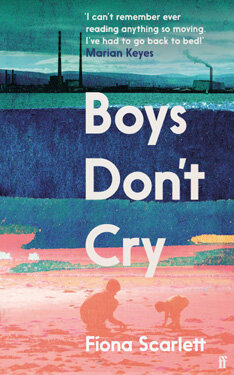
The title of Fíona Scarlett's debut novel has a deeper meaning beyond the traditional notion of masculinity where men don't show their feelings. It also has to do with expectations placed upon boys to grow into a certain mould and fulfil a particular role in their families and communities. These pressures are difficult to overcome and often lead to violent or rebellious behaviour especially for two brothers growing up as the sons of a drug dealer/muscle man for a local Dublin gang. Joe is an artistically-gifted seventeen year old who has a promising scholarship to a private school. Although he's determined not to be like his father he finds himself falling into the same traps out of financial necessity and a desire to help his friend who is indebted to the gang. His frustrations and sense of dissolution are compounded by his younger brother Finn's serious illness which drives everyone in the family to grief. The novel alternates between Joe and Finn's perspective as we follow their heartrending journey. It's a bold and sensitive portrayal of how these bright young lads must wrangle with the circumstances they are born into and the power of familial love to grant much-needed compassion when we're at our most desperate. 

I've not read much fiction that's brave enough to take on the difficult subject of a child suffering from cancer. The only other novel I can think of is “All the Water in the World” by Karen Raney. The matter is especially harrowing to read about in Scarlett's book because the voice of Finn's character is written so well that I fell in love with him. His colloquial dialogue is imbued with so much humour and humanity that I got a strong sense of his individual personality and the working-class part of Dublin he's grown up in. Equally, the tender relationship he has with his brother Joe is described so convincingly that in Joe's sections I developed a real understanding for moments when he lashes out or sabotages his own opportunities. The author is so skilful in guiding the reader through the stages of Finn's illness and the attendant agonizing feelings this evokes for the family along the way. However, I was a bit confused by the action in Joe's section which leads to a dramatic confrontation. The plot line where he carries out a task for the local gang leader felt a bit unclear to me. But this didn't detract from the powerful emotions evoked by Finn's battle with cancer and the tremendous bond of this family unit. The novel movingly shows how a family can simultaneously tear itself apart and mend itself.

Posted
AuthorEric Karl Anderson
CategoriesFíona Scarlett
7 CommentsPost a comment

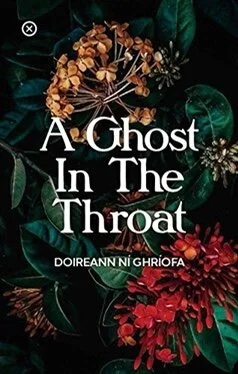
Sometimes writing has a kind of talismanic force drawing us into the past so that we feel enlivened and profoundly connected to the sensibility found in the text. “A Ghost in the Throat” is a book dedicated to such an experience. It's part memoir, part exercise in fiction and part process of translation. Doireann Ni Ghriofa meditates upon the life and writing of Eibhlin Dubh, an 18th century poet and member of the Irish gentry. After her husband's murder, Dubh composed the ‘Caoineadh Airt Ui Laoghaire' which is a long poem or dirge that is a visceral cry for this agonising loss which still feels painfully real centuries later. Ghriofa connects to this voice and it fills her imagination as she goes about her days caring for her children. She sets out to translate the poem from the Gaelic into English but is also drawn into researching and recreating what can be traced of Eibhlin Dubh's life since little is known about what happened to her following her husband Art's murder except through the recorded history of her children and their progeny. The caoineadh wasn't originally written down but orally passed along over time until it was eventually set to paper so the text is also imbued with the lives of all who've spoken it. Ghriofa meaningfully describes how this makes it a uniquely “female text” and how the state of motherhood physically connects her to a wider sense of women's history. It's extremely moving how Ghriofa describes the way Dubh becomes such a strong presence in her life and how that connection is transformative.

Ghriofa is a poet so there is a lyricism to her writing which reveals the deeper meaning and beauty of everyday tasks even while acknowledging that reality can often be habitual and mundane. Her intense desire to research the poem and Dubh's life prompts her to continue doing so even when the demands of motherhood mean her time must be parsed out in carefully planned minutes. She writes that “This is the life I have made for myself, always striving for something beyond my grasp, while hauling implausibly complex armfuls.” Yet there's a nobility to her efforts which show how this is the way in which life is meaningfully spent. The fact that so little was recorded about Dubh's life says something about the way history placed less importance on the lives of women. Ghriofa's task of tracing the barest of clues and imaginatively filling in the blanks is both an act of commemoration and a reclaiming of this female lineage. She acknowledges that “We may imagine that we can imagine the past, but this is an impossibility.” So the narrative she creates is necessarily a fiction and imbued with her own sensibility, but it takes on its own power and truth. This book is startlingly original in the way it describes how great literature can become a living presence in our lives and I loved the expansive power of Ghriofa's prose.

Posted
AuthorEric Karl Anderson
A Room Made of Leaves Kate Grenville.jpg

“A Room Made of Leaves” begins with a note from Kate Grenville in the guise of a transcriber and editor who found these pages which are supposedly the secret memoirs of Elizabeth Macarthur, a real Anglo-Australian merchant from the late 18th/early 19th century and wife to one of the most famous and wealthy entrepreneurs in New South Wales at that time. However, at the end of the book Grenville acknowledges “This book isn't history. At the same time it's not pure invention.” This playful ruse makes the novel an immersive fictional experience but it also adds to the sense of what went unsaid both in the historic documents Elizabeth left behind and concerning the circumstances that led this couple who came from humble origins to build a lucrative Australian wool industry. Grenville fictionally reimagines Elizabeth's journey from growing up among provincial Cornish farmers to her challenging marriage to her indomitable husband John to settling in the relative wildness of the New South Wales colony. It's a tale of self-invention, hidden passion and the canny resolve needed to outwit a patriarchal society in order to achieve real independence. Grenville creates a portrait of a woman with hidden veins of emotion while also atmospherically depicting the gritty reality of pioneer life in a foreign land. 

The chapters which make up this novel are quite short in length which gives the text the punchy immediacy of diary entries. I enjoyed how this kept the novel skipping along at a good pace. It's terrifying how Elizabeth becomes entangled in such a nightmarish situation marrying a brutish husband and being forced to move across the world. Yet she's intelligent enough to know the real danger of stepping out of her role and falling into an even more perilous position. At one point during the long sea voyage to their new home John becomes very ill and she realises that if he dies she'll be even more vulnerable. I found it moving and relatable how she discovers the key is to time things right to allow for opportunities for certain freedoms within this restrictive society as well as chances to discover what she really wants in life. Crucially, Grenville frames this story within the context of colonization and that the land where Elizabeth and John found rich opportunity is also a place which was stolen from the Aboriginal and Torres Strait Islanders. A mystery about what really happened during a crucial battle between the English and the native people gives a haunting quality to this intimate tale about how one shrewd woman might have triumphed over considerable obstacles to realise her full potential.

Posted
AuthorEric Karl Anderson
CategoriesKate Grenville

The shortlist for this year's International Booker Prize has been announced. You can watch this video where I watch the announcement while discussing the overall list and each book: https://www.youtube.com/watch?v=5lZND1rC6uU

I have big mixed feelings about this group of titles. I just finished reading “At Night All Blood is Black” by David Diop and think it's an incredibly powerful story about the savagery of war and how it can rob soldiers of their humanity. “The Employees” by Olga Ravn is such an inventive sci-fi novel both in how it's constructed and the story it evokes about what it means to be human. The short stories in “The Dangers of Smoking in Bed” are quite inventive but rely too much on gimmicks and twists which end most of the stories. I appreciated its imaginative invocation of the supernatural but, on the whole, it didn't entirely work for me. 

Most surprising to see here is “The War of the Poor” which is the most disappointing book I've read so far this year. I didn't feel it went into enough depth on the subject matter or the individual it focused on. I am really interested and eager to read both “In Memory of Memory” by Maria Stepanova and “When We Cease to Understand the World” by Benjamin Labatut. So I'm looking forward to getting to those over the next few weeks before the winner is announced on June 7th. I have to say I'm very disappointed the incredible novel “Minor Detail” by Adania Shibli isn't on this shortlist, but that's the way prize lists go! 

Have you read any from this list? Are you eager to read any? Let me know your thoughts on any of these books or the list as a whole. 

At Night All Blood is Black by David Diop.jpg

Military officers often describe how it's necessary to mentally and physically break recruits down so they can be rebuilt into soldiers. The idea is that creating a steely sensibility which follows the absolute authority of commanding officers is necessary for the brutality of war. Arguably, it's a process that entirely strips individuals of their humanity to transform them into killing machines. This is what the character of Alfa has turned into at the start of David Diop's “At Night All Blood is Black”. When his “more-than-brother” friend Mademba is killed during combat while they are fighting in WWI, Alfa goes on a rampage assassinating German soldiers and cutting off their hands to keep as trophies. This Senegalese soldier fights for the French army and at first they find his deadly tenacity admirable and then fear he's actually a madman or demonically possessed. Within the context of war, questions of humanity or inhumanity become dangerously confused. This intensely brilliant novel portrays the conflicts this soldier has over this issue as he literally battles through his grief and rage. In deftly pared-down prose the author powerfully describes the chaotic savagery of war and how it spiritually crushes this beautifully unique and traumatized individual. 

The story begins with Alfa's indecision about whether he should put Mademba out of his misery because his friend has been horrifically and mortally wounded and begs to die. It's an impossible situation to be in and breaks Alfa so that he embarks on his own vengeful missions. Plucking enemy soldiers at random he inflicts upon them the mutilation that Mademba experienced but he spares them the extensive suffering that Mademba felt waiting to die. This brutality is vicious but is it any more cruel than the way soldiers are ordered to destroy the enemy within the rules of battle? The captain takes Mademba to task demanding: “You will content yourself with killing them, not mutilating them. The civilities of war forbid it.” Yet, Mademba has only transformed into the savage which the French want the Senegalese soldiers to present themselves as to the Germans. They play upon racial and cultural stereotypes to more effectively intimidate the enemy and view the Senegalese as more expendable strategically placing them in more dangerous situations than the French soldiers. It's compelling how the novel examines the way prejudice plays a part in these battles which are about more than fighting on one side or another.

Though the prose style of this book is stripped down, the word choice and dramatic situation speaks volumes in relaying complex ideas about what it means to be human. The writing also gradually develops a poetic rhythm in how it follows Mademba's logic. He frequently invokes the refrain “God's truth” when pressing a particular point and the flow of his thoughts evocatively bring his clashing emotions to life. The later parts of the book also describe Alfa's past and his community in a way that the French he fights for has chosen to ignore. It's so moving how we get small insights into his background and the possible future he wanted to build with his friend Mademba. Some readers may be put off by the horrendous violence this novel contains, but I admire how it honestly confronts the raw brutality of armed conflict and the complex impact this has on those who get indoctrinated into warfare.

Posted
AuthorEric Karl Anderson
CategoriesDavid Diop
2 CommentsPost a comment
Consent Annabel Lyon.jpg

“Consent” begins with interesting dynamics between two sets of sisters. Identical twins Saskia and Jenny have very different personalities. Where Saskia is studious and humble, Jenny is glamorous and thrill-seeking. Then there are Sara and Mattie who have a very different relationship with each other because Mattie's mental disability means she needs daily assistance. Though Sara enjoys fine wine and expensive clothes she must take on the more modest role of being a carer when their mother dies. Annabel Lyon alternates between the stories of these sisters over a period of almost thirty years. At first we're left wondering what the connection is between these two stories, but eventually a commonality is revealed which leads to a suspenseful conclusion. It's interesting how these women's contrasting stories give a different perspective on sisterhood and how challenging it is to form an individual identity apart from being a sibling. However, I felt it turned into too much of a thriller about revenge which prevented me from emotionally connecting with the plight of these characters. 

At first I felt really drawn into Sara's story when she was still young. Her passion for fashion drives her to relentlessly seek the respect of the snobbish staff of a high end shop and spend almost all of her inheritance on designer clothes. Strangely, as the story progressed, I felt that there was less distinction between the characters even as they grew older and circumstances forced them into very different situations. I would have preferred it if the novel focused on the story of only one pair of sisters. There are other novels such as “The Vanishing Half”, “A Saint from Texas” and “The Looking-Glass Sisters” which I feel have more compellingly described the alternating feelings of connection and disconnection in different kinds of sisterly relationships.

I did find it moving how Sara's distress about her sister's fate drives her into a circular self-destructive pattern. The author writes, “She's chained in the masturbatorium of her own guilt”. This is an evocative way to describe this state since grief sometimes drives people into forms of masochistic behaviour. But the overall issue of where consent tips over into victimhood is used more as a plot device and I didn't feel the story conveyed the psychological complexity of this issue as meaningfully as it could have. Also, both Saskia and Sara seemed to lack motivation until they were driven by a common purpose so I found it hard to care about them. The story raises some intriguing ideas and I liked the author's tightly-controlled writing style filled with sharp declarative sentences, but I ultimately found the story a bit disappointing.

Posted
AuthorEric Karl Anderson
CategoriesAnnabel Lyon
How the One-Armed Sister Sweeps Her House by Cherie Jones.jpg

The beach in Barbados where this novel is set may be promoted in tourist brochures as a holiday spot known as Paradise, but the reality is anything but idyllic. On the other side of high-walled expensive houses the real residents of this area dwell in much more ramshackle accommodation and many barely make a living by working as cleaners, hairdressers, drug dealers or prostitutes to visiting foreigners. Economic disparity couldn't be any more evident and the way this is so sharply described shows how it underpins much of the horrific violence in this novel. The story mainly switches focus between two characters. There is Lala, a young wife, mother to a newborn baby and island resident who is the victim of persistent domestic abuse. And there is also Mira Whalen, a woman who married into wealth and whose husband is shot dead during an attempted robbery of their upscale holiday home. The novel explores the way their stories intersect alongside a group of characters surrounding them and frequently tunnels into their backstories. However, events primarily revolve around dramatic crimes which occur in the late summer of 1984. 

As in many instances of extreme poverty and desperation, violence against women is prevalent in this community. The novel shows how this physical and sexual brutality persists through generations. Lala's husband Adan vocalizes his justification for beating his wife and makes her feel like she deserves what he's doing to her. This is infuriating and frightening to read about, but one of the most shocking things about this story is the sense Lala's grandmother Wilma gives that women are to blame because men can't help their lust which leads to aggressive and sexually abusive behaviour. Therefore, she turns against her own daughter and granddaughter. This meaningfully shows the way a patriarchal sensibility poisons the minds of everyone who lives here. So, while it's difficult to read about the many kinds of abuse and violence portrayed in this novel, it's also powerful how it conveys the deeply ingrained sexist dynamic of this particular society. There's also a strong element of suspense running throughout the book. I read it compulsively as I had to know what was going to happen to Lala, Mira and Lala's longtime flame Tone. The ending is suitably explosive! The one-armed sister of the title refers to an allegory which Wilma tells Lala as a girl and I enjoyed how the conclusion of the novel makes an ironic statement which undermines the moral of Wilma’s tale which was meant to keep Lala in check.

Because of You Dawn French.jpg

It was a bit of a surprise when I saw a novel by Dawn French on this year's Women's Prize longlist since I knew she'd written a memoir but wasn't aware she wrote novels as well. Of course, I'm a fan of her work as a comedian so I was excited to try her fiction. “Because of You” is a family drama concerning a newborn girl that's stolen from a hospital by a grieving mother whose child died in birth. Minnie is raised by loving mother Hope without any knowledge of her true origins. But, when Minnie becomes pregnant as a teenager, the truth must come out and there are dramatic consequences as she's reunited with her birth parents Anna and Julius. That's a bit of a spoiler but I don't think the plot is the best thing about this book. Where it's most successful are in the lively characterisations and scenes which are imbued with a wry sense of humour. It also realistically portrays a racially diverse cast of characters without making the politics of skin colour a primary element of the story. 

I felt very emotionally engaged by the opening section of this book but, as the story progressed, it came to feel increasingly melodramatic and sentimental so it turned into something like a soap opera. The characters' actions seemed more directed by the plot rather than feeling logical or real. In particular, I felt the character of Anna was thinly drawn and it was hard for me to believe she'd act so graciously given the circumstances. There are some funny and tender moments within the story but overall it felt a bit too forced for me to fully enjoy it or find it impactful. It's a bit unfair to react to French's writing in connection to her celebrity status. However, I feel like there are some well-known public figures such as Graham Norton who've written popular novels which are fine but they probably receive undue attention just because the authors are already known to the public. I probably wouldn't be so harsh criticising this novel if I weren't reading it in the context of a book prize because I think it's mostly enjoyable, but I don't think it's as impactful as the other books listed for this award.

Posted
AuthorEric Karl Anderson
CategoriesDawn French
The Dangers of Smoking in Bed Mariana Enriquez.jpg

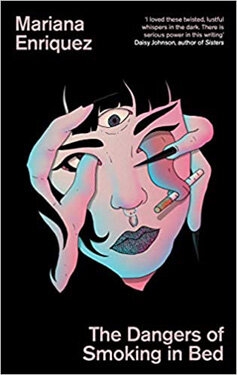
It's so exciting to read new fiction that imaginatively blends the surreal and supernatural to tell inventive (oftentimes horrific) literary tales. In Enriquez's short stories the narrators are often haunted by ghosts or plagued by curses. Spirits enact their revenge. Communities are driven into a frenzy by fear. These stories frequently focus on or are told through the points of view of the vulnerable and maligned: children who are impoverished or abused, disenfranchised teenagers or deviants. Neither the protagonists or the ethereal beings often adhere to a moral code. Many act deviously, tyrannically or selfishly. An abused woman is entrapped by a hotel's ghost. The “evil” which plagues a family is transferred onto an innocent girl. A young filmmaker knowingly films and sells videos of children swimming in a pool to a paedophile. The depiction of the sheer chaos of this society which doesn't necessarily reward the good or punish the bad is in many ways more terrifying than the sensational violence or gross details portrayed. It suggests a world that is restless and unhinged. These tales are filled with a lot of tantalizingly dark detail and imagery, but the problem is they too often rely on a twist or gimmick in their plotting. This frequently left me reeling (or rolling my eyes) from the shock of what's revealed rather than being moved by any profundity or psychological insight. 

Interestingly, I felt the final story in this collection 'Back When We Talked to the Dead' was the most successful. This is narrated from the collective point of view of a group of girls recalling a time when they secretly met to use a Ouija Board in order to contact or locate people they've lost. Their connection with the spirits is severed one night when a session ends in a terrifying way. This story hints at institutionalized violence which has led to people disappearing or falling between the cracks of a dysfunctional social system. The point of view evocatively brings to life the voices of friends who were once united but have grown apart because of age and the abiding fear of their actions. It's also genuinely tense and scary as we discover what freaked out these girls so much. Sadly, too many of the previous tales feel like they are self-consciously striving to disturb the reader. Two stories feature people defecating in the streets and multiple female characters aggressively and violently masturbate. I'm not prudish but the repetition of these kinds of details simply revolted me rather than engaged me. I can't see anything revelatory in this specific realism; it's just stomach turning.

The longest story in this book 'Kids Who Come Back' is almost novella-length and explores a theme common to many of the stories. Children frequently disappear in this collection only to return in an altered state where all innocence has been lost. This lengthy story is narrated from the point of view of a woman named Mechi who literally maintains an archive of lost and disappeared children in Buenos Aires. She becomes fascinated by a beautiful missing girl named Vanadis who abruptly returns one day, but not in as the person she was before. Many other lost children also reappear including many of whom definitely died and they are the same age they were when they vanished. People grow to fear them and see them as shells of the children they once were. This is a premise somewhat similar to another Argentinian story 'Underground' by Samanta Schweblin. I feel like Enriquez is able to more effectively build and draw out tension and mystery in this longer story. It better describes doubles or doppelgängers which appear in several tales. It's also more pointed in how it encapsulates a frequent theme of this collection where a neighbourhood or area and a group of people are “tainted” by a scandal or popular myth so they are in a sense “cursed”. The resulting social alienation is just as cruel as the rancour of the spirits. Perhaps the many positive elements of this longer story mean that I'd find Enriquez's fiction more successful in the form of a novel where her rich imagination can be given a constructive amount of room to stretch.

Detransition Baby Torrey Peters.jpg

Pregnancy is a traditional storyline that's part of many domestic dramas. With the prospect of a child those involved must decide whether to see this pregnancy through to birth and, if so, how they will make room in their lives for a baby and organize themselves as a family unit to support the child whether that's as a single parent, a married (or unmarried) couple or an extended family. Torrey Peters portrays this universal situation with the inclusion of a trans woman and an individual who has detransitioned. Katrina is a successful businesswoman who discovers she's pregnant while having an affair with her employee Ames. Neither are certain they can handle the full responsibilities of parenthood. Meanwhile, Ames reveals to Katrina that he'd previously transitioned to being a woman before transitioning back to being a man. While he was a trans woman he had a serious relationship with a trans woman named Reese. Although Reese has a tempestuous personality she has strong maternal urges so Ames proposes she could help them both raise the child. Peters brilliantly traces the compelling and complex story of these three characters in the time leading up to and proceeding conception. 

I'd been wanting to read this novel since it was first published but was encouraged to prioritise it after it was longlisted for this year's Women's Prize for Fiction. There's been a controversy around the book being listed for this prize because the author is a trans woman and some readers object to the way female identity is portrayed in the story. I almost don't want to mention these claims as I don't believe they are credible and demonstrate damaging and prejudiced views against trans women. Yet to completely pretend the furore surrounding the novel isn't happening is to ignore the political questions this story wholeheartedly engages with. Peters addresses many issues to do with transphobia and trans identity within the story showing the full complexity of arguments that are occurring within the trans community, the overall queer community and society as a whole. The story skilfully represents many perspectives while also portraying views that are particular to these specific characters. The novel fully deserves recognition on this prize's list because it engages with an important dialogue about womanhood and how the concerns of many different women often intersect, but moreover it's an extremely enjoyable and well crafted novel.

The tension in this story emerges not just out of the question of this pregnancy but the many explosive or contemplative scenes where the characters have tense conversations or an inner dialogue about their circumstances. There are so many funny and tender moments as well as instances of emotional vulnerability where characters grapple with complex issues to do with sexuality and gender identity. It's pleasurable how pop culture references are frequently integrated into the characters' metaphorical understanding of the world. Humour often arises from the snappy dialogue but also the way characters frequently trip over their own contradictions and the irony of their situations. This makes them very relatable and I felt like I intimately knew all three main characters by the end. I also felt close to Ames and Reese as we get memories of their development which portray the pain, pleasure and hope both experience amidst their personal evolution. A scene where Ames (when he was Amy) first goes to a clothing store for transexuals felt particularly vivid as it's both a liberating and shameful experience. I also admire the way the novel boldly portrays the way people can act in self-destructive ways – especially when it comes to sexual relationships and how what we desire can contradict our moral beliefs. Most of all, it's such an engaging, intelligent and compelling story that takes seriously the dilemmas and struggles of its individual characters and the political issues which arise out of this family affair.

Posted
AuthorEric Karl Anderson
CategoriesTorrey Peters
Small Pleasures Clare Chambers.jpg

If you hate the ending of a novel after really enjoying the majority of the story is it still a successful reading experience? It's a tricky question and one I've been left pondering after finishing “Small Pleasures”. Set in the late 1950s it follows Jean, a journalist at a local paper in the suburbs of London. Though she's around 40 years old she still lives with her mother whose cantankerous and overbearing manner leaves little room for Jean to have a personal life. Jean is assigned to write a feature about Gretchen, a Swiss woman who claims her daughter is the result of a virgin birth. During the process of researching this curious case Jean gradually develops a personal relationship with Gretchen, her husband Howard and their daughter Margaret. The author skilfully evokes the atmosphere of mid-20th century England alongside a compelling mystery which plays out in such an interesting way. It's a delight how Jean's fluffier news pieces about domestic matters are interspersed throughout the novel. Most of all, I grew to feel strongly emotionally involved with Jean whose quiet but painful loneliness is assuaged by her growing affection for this family. It's also very intriguing how this personal story intertwines with the facts Jean uncovers surrounding Margaret's birth. But the novel ends with a dramatic event which feels entirely disconnected from this gentle and beautifully immerse tale and it's left me feeling betrayed.

I'm not someone who needs a happy ending in novels. Even if I come to feel so attached to characters that I hope to see separated lovers reunited, good individuals rewarded and villains get their just deserts, I can accept it when things don't work out for the best because that often happens in life. But I think the conclusions of novels ought to be consistent with the tone of the story and stay true to the integrity of the characters I've come to care about after following them for hundreds of pages. It's true that disasters occur and the chance of being caught in such a horrific circumstance is a reality we wake up to every day. At any moment the narrative of our lives can be horrifically thrown off-kilter by such an occurrence. However, in a novel such unexpected events should be integrated into the story in a way that allows the reader to emotionally process a calamitous occurrence alongside the characters. That's why novels plotted around dramatic events often follow the aftermath so we can see how people survive or falter when confronted with tragic loss.

The way “Small Pleasures” ends simply left me feeling cold and manipulated because it's like the trust I'd formed over the course of the narrative had been broken. The afterward of this book made matters worse because the author describes how she wanted to self consciously incorporate two historical incidents into one novel. But the way she did this felt tacked on rather than artfully blended into the story. I'd rather not have spent so much time focusing on these final pages because I truly feel the majority of this book is moving and well done. It's poignant how there are storylines about suppressed same sex desire, the way family members can become overly burdened with becoming their relatives' carers and issues to do with untreated mental health problems. But I feel like the conclusion of this novel taints the overall experience of the story which is very unfortunate.

Posted
AuthorEric Karl Anderson
CategoriesClare Chambers
35 CommentsPost a comment
Nothing but Blue Sky Kathleen MacMahon.jpg

One of the reasons I love reading is so I can get a sense of people's lives and situations that are very different from my own. So it presents an interesting personal challenge to encounter a novel about a man who I feel like I already understand as he's similar to many men I've known throughout my life. The narrator of MacMahon's “Nothing But Blue Sky” is David, a middle class, middle age Irish journalist. He's a bit grumpy, unfailingly practical and drags his feet when he has to go to social occasions. In some respects he's probably like the man I'm rapidly becoming. But he also has a morbid sense of humour which is imbued with an underlying contempt for the people he's blithely making fun of and I find this kind of masculine comedy particularly odious. His jovial, kind-hearted wife Mary Rose provides the perfect counterbalance to him. But she died in a tragic event and when the novel begins we meet David as he is grieving for the woman he might not have ever fully understood or fully appreciated. He recounts his memories of her, the awkward process of continuing to holiday with friends without her and discovers new familial connections which he never knew existed. 

MacMahon presents the pain of his grief and his lingering regret in a sympathetic way. Of course, I have empathy for his situation but the difficulty for me is that he's not the kind of character I'm naturally interested in reading about. I know this says more about the kind of person I am than it does about MacMahon as a writer and I think the novel is partly about the question of whether privileged men like David are often unfairly overlooked. Is there more to a man like David than I'm willing to give him credit for? I'm still not sure after having finished the novel. Certainly, the pain of his situation is no less sincere or deeply felt than anyone else's. David is exactly the sort of character Anne Tyler often writes about with great profundity. But, while there are moments of insight and pleasure in MacMahon's novel, I found spending so much time in David's head somewhat tedious as if I were forced to sit next to him and make conversation. However, MacMahon does present interesting dilemmas which I continue to wonder about. What would have happened to David and Mary Rose's relationship if it hadn't abruptly ended in tragedy? Like all the unrealised possibilities in life this question haunts David's ongoing existence in an intriguing and troubling way.

Posted
AuthorEric Karl Anderson
2 CommentsPost a comment